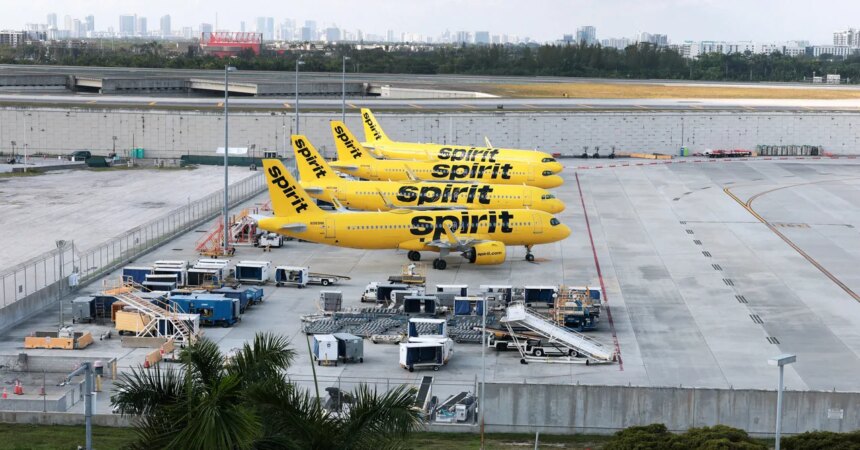
Things have taken a dramatic turn for Spirit Airlines, a budget airline known for its minimalistic service model, which abruptly announced its closure on Saturday. This decision comes after the company had filed for bankruptcy twice, first in 2024 and again in 2025. The suddenness of this development has left many passengers stranded as the airline canceled flights, shut down its customer service lines, and laid off a significant portion of its workforce without prior warning.
The slow decline of Spirit Airlines has been evident over the last several years, as the airline hasn’t turned a profit since 2019. More formidable competitors like Delta Air Lines and American Airlines began encroaching on Spirit’s budget-conscious market by unbundling ticket offerings, thus providing cheaper, no-frills fares. In 2022, the U.S. Department of Justice intervened to block a proposed merger with JetBlue, arguing that the merger could lead to increased airfares across the board. Following a lengthy trial in early 2024, a federal judge ruled against the merger bid.
The airline’s efforts to revive itself were thwarted by a combination of factors, including two bankruptcy filings and subsequent cuts in staffing, routes, and flights. The final blow came from escalating geopolitical tensions, particularly involving the Iran War and the ongoing crisis in the Strait of Hormuz, which contributed to a sharp spike in fuel prices. Airlines typically allocate over 25% of their operational costs to fuel, further complicating Spirit’s already precarious financial situation. In a recent court filing, Spirit’s legal team stated, “Recent geopolitical events have resulted in a massive and sustained increase in fuel prices … There are no longer any viable paths to a restructuring or continued operations.”
Passengers holding Spirit tickets are advised that the airline will automatically refund fares. However, those who made reservations through third-party sites should reach out to those vendors for refunds. Travel expert Katy Nastro emphasizes that rebooking should be a top priority for affected travelers. The travel landscape is already shifting, with ticket prices for U.S. flights up nearly 15% year over year. Some routes, especially popular destinations like London and Hong Kong, are experiencing even steeper price increases.
Major airlines, including United, Delta, JetBlue, and Southwest, are stepping in to offer capped ticket prices for a limited time for those affected. American Airlines and Delta are providing discounted fares on high-demand routes previously served by Spirit, while Allegiant Airlines has frozen fares on overlapping routes. Additionally, Frontier Airlines is extending up to 50% off base fares for former Spirit customers for a brief period.
For those who rely on air travel but were never Spirit customers, it’s advisable to act fast when booking flights. With Spirit’s abrupt exit from the market, the remaining airlines may see a surge in demand for their services, potentially driving prices up by 15 to 20%.
The repercussions of Spirit’s closure extend beyond just travelers. Most major U.S. airlines have offered stranded Spirit employees travel passes and jump seats to return home. Some airlines are even providing preferential employment interviews for these workers. Aviation experts predict that over time, many Spirit employees will secure positions within the broader airline industry, although some may need to relocate or shift to different employment sectors.
Spirit’s fleet of airplanes is composed entirely of Airbus A320s, a popular model that will not go unused. Out of its 131-plane fleet, 82 were leased and will be returned to their lessors, while the remaining 49 owned aircraft will be sold off.
The closure of Spirit Airlines raises concerns about the future of ultralow fares in the U.S. While travelers often criticized Spirit for its various fees and unpalatable in-flight experiences, it was one of the few remaining budget airlines offering one-way fares below $100. With increasing fuel prices and shrinking competition, the prospect of maintaining low fares looks grim. Without the pressure of competing with Spirit, other airlines may have little incentive to lower their prices when they can fill seats at higher rates.