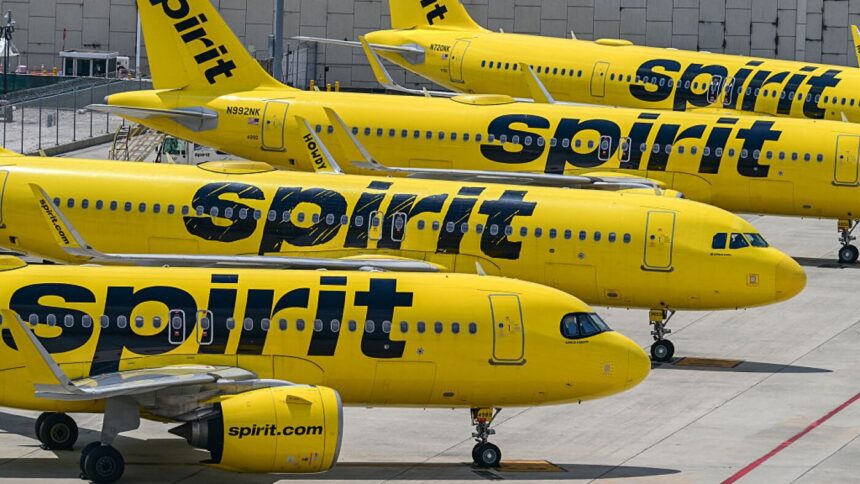
Most of Spirit Airlines’ fleet remains grounded following the airline’s abrupt cessation of operations. This came after a successful run from Fort Lauderdale, Florida, to Phoenix Goodyear Airport, which was notable for being a ferry flight carrying no passengers, only a skeleton crew tasked with transporting the aircraft to Arizona for storage.
The shut down left over 90 Spirit planes at various airports across the United States, alongside a trove of assets including engines, spare parts, and real estate. Within days of halting flights, Spirit’s legal representatives sought court approval for an “orderly wind-down of operations.” A significant complication is that the majority of Spirit’s aircraft—over 60—are leased, with the actual owners keen on reclaiming their planes.
As Steve Giordano, managing partner at Nomadic Aviation Group, explained, there’s an urgent movement to reposition these planes. “Some are already probably in the pipeline to be leased again,” he noted. Giordano elaborated that while some aircraft will have their engines removed for repurposing, others may be disassembled for parts, and some remain without a clear future.
Simultaneously, Spirit is actively looking to monetize its remaining assets. Court documents reveal that the airline has 28 aircraft available for sale, all belonging to the Airbus A320 family. Furthermore, Spirit has valuable real estate assets—including an office building in South Florida, maintenance facilities, and prime airport gates—potentially attracting interest from other airlines. Henry Harteveldt, an airline analyst, pointed out the strategic locations of Spirit’s gates in highly trafficked airports in Houston, Dallas, Las Vegas, and Los Angeles, suggesting there could be significant industry interest in acquiring them.
In addition, Spirit holds prized takeoff and landing slots at New York’s LaGuardia Airport and Newark Liberty International Airport, which could be appealing to other airlines. Ahmed Abdelghany, a professor of operations management at Embry-Riddle Aeronautical University, mentioned, “You can easily sell slots at those constrained airports, and many airlines will be in line to buy them.”
However, the repossession process is proving challenging. Currently, Spirit’s planes are scattered at different airport gates, complicating retrieval efforts. Giordano described the situation as a “mass confusion” environment, where individuals attempting to reclaim the aircraft often face resistance. Pilots sent by Nomadic to recover the planes, sometimes recent Spirit employees, have encountered obstacles such as airport security concerns.
The operational difficulty is compounded by the high cost of jet fuel, which has surged approximately 70% since the escalation of conflict in Iran. This makes several of Spirit’s planes less attractive to potential buyers and adds another layer of uncertainty to the market. Harteveldt acknowledged these challenges, stating that while buyers will eventually emerge, the process may take longer than it would have under more favorable conditions just months ago.
As a result, many of Spirit’s bright yellow planes may remain idle in Arizona’s deserts for the foreseeable future, while both Spirit and its creditors navigate this tumultuous landscape.