Stock futures experienced a decline on Wednesday night as the market processed mixed results from major technology companies and the Federal Reserve’s recent decision on interest rates. Futures linked to the Dow Jones Industrial Average dropped 30 points, reflecting a decrease of 0.06%. S&P futures also fell by 0.12%, while Nasdaq 100 futures saw a decline of 0.2%.
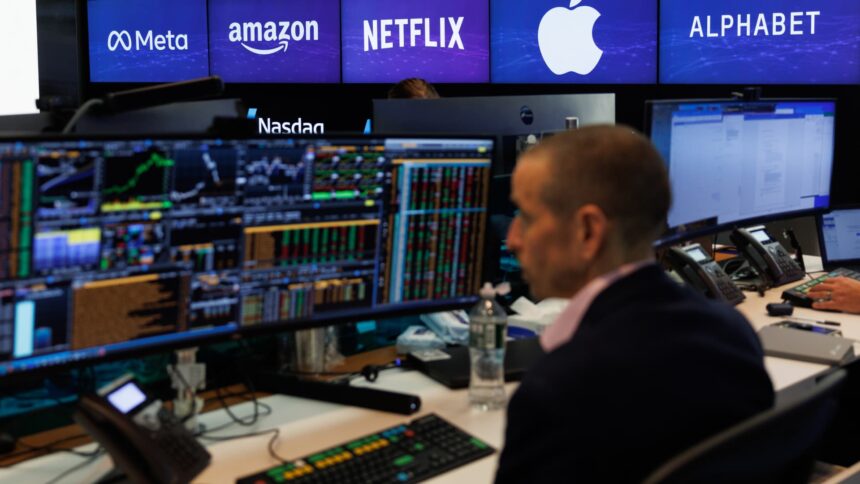
This downturn in futures follows the release of quarterly earnings from megacap tech giants Alphabet, Meta, and Microsoft, all of which were closely watched for insights into the current state of the artificial intelligence sector. Alphabet, the parent company of Google, saw its shares rise approximately 6% after reporting strong earnings. Conversely, both Meta and Microsoft faced significant drops in their share prices, falling about 8% and 4% respectively. The negative market reaction to these tech earnings weighed heavily on broader trading during after-hours.
Meta announced it achieved its highest revenue growth since the first quarter of 2024. However, the company disclosed a one-time charge of $15.93 billion due to President Donald Trump’s One Big Beautiful Bill Act, which it anticipates will lead to increased federal cash tax payments in the current and future years. Microsoft’s stock declined following an announcement that its investment in OpenAI had caused a $3.1 billion reduction in its earnings for the quarter. This revelation raised concerns regarding the sustainability of current AI expenditures.
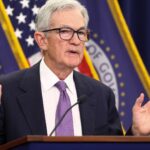
Earlier in the trading session, the Dow Jones Industrial Average had already slipped by about 0.2%, or roughly 74 points, after briefly reaching a record high. Meanwhile, the S&P 500 remained largely unchanged, and the Nasdaq gained nearly 0.6%. The Dow’s decline was notably influenced by comments from Federal Reserve Chair Jerome Powell, who indicated that there was no certainty regarding potential interest rate cuts in December—a prospect that many investors had been anticipating. Powell stated, “A further reduction in the policy rate at the December meeting is not a foregone conclusion. Far from it,” following the Fed’s decision to lower its benchmark overnight borrowing rate by a quarter percentage point, bringing it to a range between 3.75% and 4%.
Chris Maxey, chief market strategist at Wealthspire Advisors, commented on the Fed’s recent actions, remarking, “The interest rate cut was the easy part as markets were giving the Fed breathing room.” He noted that despite an appropriate balance between monetary policy and labor/inflation dynamics, Powell’s remarks regarding a potential absence of conviction on a December rate cut may initiate a cautious market response.
CFRA chief investment strategist Sam Stovall remarked that the Federal Reserve might have to be more aggressive in cutting rates than it currently suggests if tech earnings indicate that productivity related to artificial intelligence is accelerating quicker than expected. Stovall also highlighted that October is historically the most volatile month in the financial calendar, suggesting that upcoming market fluctuations might offer traders potential buying opportunities.
In a separate development, the market is closely watching a significant meeting between President Trump and Chinese President Xi Jinping set to take place late Wednesday. This dialogue could shed light on US-China relations amid ongoing trade tensions, making it a crucial event for investors.