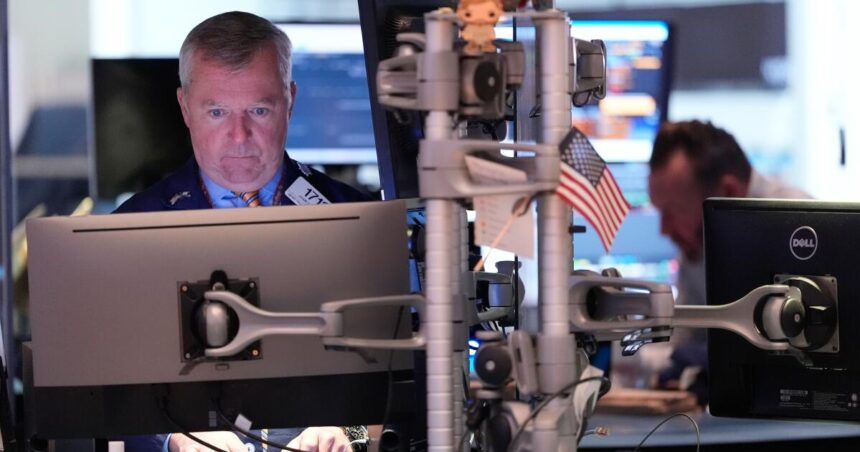
The stock market experienced a significant downturn on Monday, primarily influenced by a continued decline in high-profile technology stocks, particularly those connected to the burgeoning field of artificial intelligence. The S&P 500 fell 0.9%, distancing itself further from the record high it achieved just last month. The Dow Jones Industrial Average suffered an even steeper drop of 557 points, or 1.2%, while the Nasdaq composite declined by 0.8%.
Nvidia, a key player in the AI sector, was a major contributor to this slide, with its stock slipping 1.8%. The company has been a focal point of market volatility in recent weeks, with its performance painting a broader picture of the tech landscape. Other companies that benefited from the AI boom also faced losses, including Super Micro Computer, which plunged 6.4%. The negative trend cascaded through other previously high-performing areas; Bitcoin plummeted below $92,000, significantly down from nearly $125,000 last month. This decline affected cryptocurrency-related companies, with Coinbase Global falling 7.1% and Robinhood Markets dropping 5.3%.
Market analysts and critics have long warned that the stock market may be due for a correction, particularly pointing to inflated valuations that have surged since April. The bullish sentiment surrounding AI stocks, which have shown extraordinary growth in recent years, is now under scrutiny; the market’s future direction will largely depend on whether these companies can meet or exceed heightened profit expectations.
Despite Monday’s losses, Nvidia’s stock has still seen a remarkable 39% increase this year, even after experiencing four price doublings within the last five years. The market will closely watch Nvidia’s earnings report scheduled for Wednesday, which will reveal the company’s profitability over the summer. Investors are eager to see if the expectations built around AI stocks can materialize in solid financial results, as any disappointment could challenge the optimistic assumptions that have driven stock market highs.
Beyond technology, other sectors also felt the pressure. Aramark shares dropped 5.2% after reporting a quarterly profit that failed to meet analysts’ forecasts. The company, which specializes in food and facilities management, indicated a projected profit growth between 20% and 25% for the coming year—while robust, this forecast was still less than what market analysts had previously expected. In contrast, Alphabet’s stock surged by 3.1% after Berkshire Hathaway announced a significant investment in the tech giant, further showcasing the complexities of market dynamics amidst contrasting performances.
The overall market sentiment reflected in the S&P 500, which declined by 61.70 points to finish at 6,672.41, while the Dow closed at 46,590.24 after the drop of 557.24 points, and the Nasdaq ended down at 22,708.07, down by 192.51 points.
Adding to the uncertainty is the Federal Reserve’s upcoming decisions regarding interest rates. There had been a consensus that the Fed would implement further cuts to stimulate a slowing job market, a strategy that Wall Street typically welcomes. However, concerns are mounting regarding the possibility of further cuts at the December meeting, particularly in light of persisting inflation that remains above the Fed’s target of 2%. The recent government shutdown has delayed crucial updates on job markets, leading some Fed officials to advocate a wait-and-see approach until they gain more clarity.
The government is set to release the delayed September jobs report on Thursday, which could induce further market volatility. Strong employment data may deter the Fed from cutting rates, while weak numbers could raise concerns about economic stability. Analysts predict that in the coming year, the Fed might only consider rate cuts in response to a significant economic downturn rather than attempting to preemptively stimulate growth.
In the bond market, yields on the 10-year Treasury fell slightly to 4.13%, down from 4.14% at the end of the previous week. International markets mirrored the downturn, with indexes declining across much of Europe and Asia. Japan’s Nikkei 225 recorded a minor decline of 0.1%, following news of an annual economic contraction of 1.8% for the July-September quarter. In contrast, South Korea’s Kospi emerged as an exception, gaining 1.9% on the strength of its technology sector.