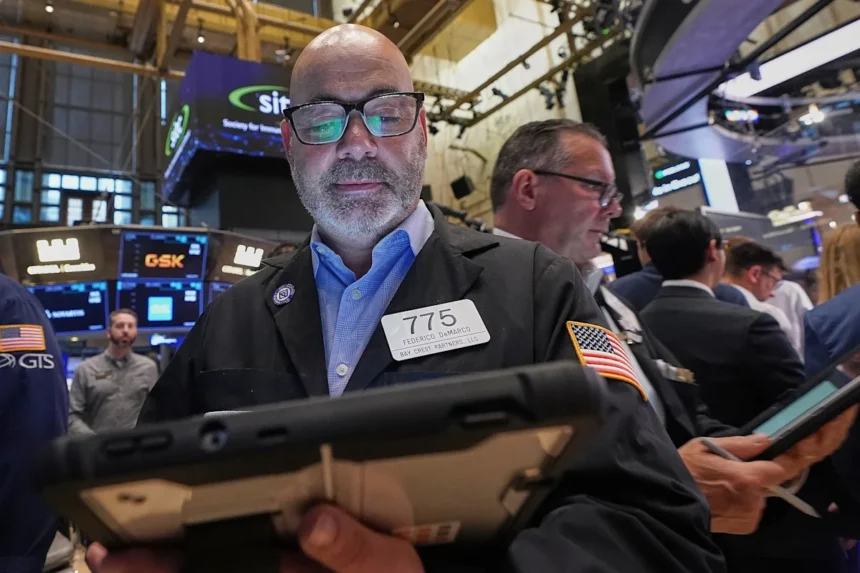
The stock market experienced a notable surge during the first half of 2026, largely ignoring ongoing geopolitical tensions in the Middle East, a significant oil shortage, and concerns regarding a potential bubble in the artificial intelligence sector. The Dow Jones Industrial Average is on track for its most robust first half since 2021, having increased 8.9% to surpass the 52,000 mark. Similarly, the S&P 500 saw a rise of 9.4%, while the Nasdaq, dominated by technology stocks, soared by 12.5%.
Analysts attribute the upswing in stock prices primarily to a year marked by strong corporate earnings, bolstered by a resilient economy and consumer willingness to spend despite inflationary pressures. Ed Yardeni, president of Yardeni Research and a former chief investment strategist at Deutsche Bank, emphasized that this year’s performance reflects solid fundamentals as opposed to mere market narratives. “Earnings have been very, very strong,” he said, noting the economy’s surprising resilience.
The initial months of 2026 saw the economy rebound effectively, recovering from a sluggish end to the previous year. Job gains exceeded expectations, with an average of approximately 114,000 jobs added each month from January to May, dispelling recession fears. Consumer spending, which represents roughly two-thirds of U.S. economic activity, also picked up, as reported by the Commerce Department.
Callie Cox, chief market strategist at Ritholtz Wealth Management, remarked on the turnaround, stating, “At the end of last year, the job market was in question and consumer spending was pretty lukewarm. The economy has really impressed in the last six months.” This momentum has played a crucial role in supporting stock market growth and driving corporate earnings upward.
The rise in share prices has also been significantly influenced by AI chipmakers, which have outperformed expectations, enabling major stock indexes to rebound from a slow phase experienced by many prominent technology companies. For instance, shares in Micron surged by 306% since January, while Sandisk skyrocketed by an astonishing 830%. This stellar performance by semiconductor firms has helped offset the underwhelming contribution from the so-called “Magnificent Seven,” which includes giants like Meta and Tesla. Meta’s shares have decreased by 15% this year, and Tesla is down 7%, with Nvidia also not keeping pace with the S&P 500’s growth.
Market analysts have expressed varying predictions about the outlook for the remainder of 2026 amid challenges like elevated inflation and a robust labor market, which could lead to potential interest rate hikes. Fed Chair Kevin Warsh caused a brief drop in stock prices during his inaugural press conference, as he reaffirmed the Federal Reserve’s commitment to controlling inflation, currently exceeding the target rate of 2%. Futures markets suggest a roughly 66% chance of an interest rate hike in September, according to the CME Group’s FedWatch Tool.
Yardeni anticipates continued market growth in the second half of the year, projecting a further 9% increase in the S&P 500. However, analyst Tyler Richey from Sevens Report Research expressed skepticism, predicting a downturn in major indexes by year’s end. Richey pointed out that initial expectations for interest rate cuts have shifted towards a more pessimistic outlook on potential rate hikes, indicating rising risks for corporations that depend on low borrowing costs.
As uncertainty looms, Richey acknowledged the challenge of predicting market trajectories. “It has been extremely challenging to time this market,” he concluded, reflecting the cautious optimism that characterizes the current financial climate.