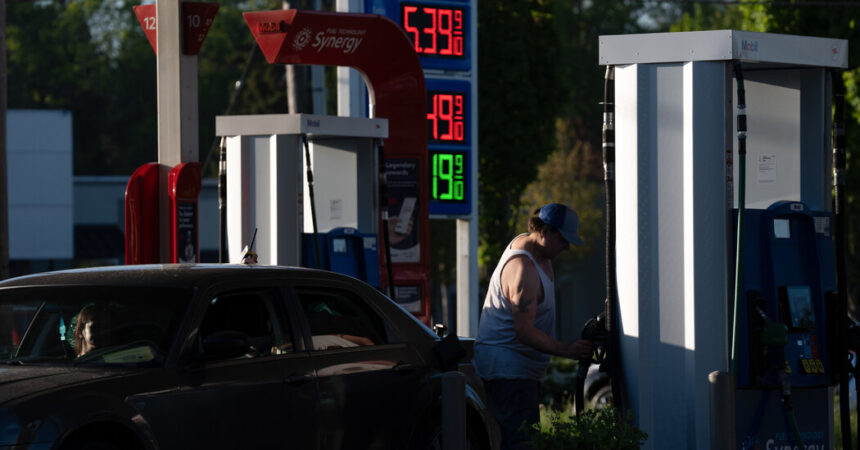
Surging gas prices are exacerbating the economic divide in America, placing a heavier burden on lower-income households struggling to manage escalating costs at the pump. Following more than two months of conflict in the Middle East, the national average gas price has soared past $4.50 a gallon. An analysis by the Federal Reserve Bank of New York highlights how this surge disproportionately affects those with the least financial flexibility.
Economists at the New York Fed report that while higher-income individuals ramped up their gasoline spending in March, their overall consumption—when adjusted for inflation—remained relatively stable. This indicates that wealthier households can absorb the changes without significantly altering their driving habits. Conversely, lower-income families are spending significantly more on gas compared to past months but are buying less fuel overall, likely opting for less driving, carpooling, or using public transit when available.
The report, entitled “A K‑Shaped Pattern at the Pump,” illustrates the ongoing “K-shaped” economic recovery, where higher-income households enjoy relative prosperity, driving growth, while those at the bottom continue to struggle. Recent geopolitical tensions, particularly Iran’s closure of the Strait of Hormuz—a vital energy route—have contributed to oil prices escalating more than 50% from pre-war levels. Although oil prices briefly fell following diplomatic efforts from the U.S., they remain significantly elevated compared to earlier in the year.
In Charleston, South Carolina, individuals like Danielle Sollers, a driver for ride-sharing services, have felt the pinch immensely. Gas prices exceeding $4 a gallon have strained her budget. “I was paying well below $3 a gallon… then it felt like, within a week or so, it spiked,” she recounted, noting how her costs have risen sharply from about $25 per fill-up to over $40, which has significantly impacted her earnings, especially on slower days.
The ripple effects of rising oil prices extend beyond gasoline, influencing costs for diesel, jet fuel, fertilizers, and plastics. Food inflation is expected to rise as increased transportation costs filter through the supply chain. Comparisons to past crises highlight how similar energy price spikes during Russia’s invasion of Ukraine led to widespread commodity turmoil and inflation, albeit with different underlying causes driving the current situation.
Experts like Gbenga Ajilore, chief economist at the Center on Budget and Policy Priorities, note that the current energy crisis is more tied to domestic policies than external events. He describes the pressures consumers face at the pump as a “self-created conundrum” linked to previous geopolitical tensions.
In light of the current inflationary landscape, economists project that the inflation rate could peak around 4.5% this summer, significantly surpassing the Federal Reserve’s target of 2%. Despite expectations that the U.S. economy could dodge a recession this year, disparities in wage growth are worsening financial inequalities across the nation. Higher-income families have seen wage increases of 5.6% annually, while lower- and middle-income households experience only 1% to 2% growth—the widest gap seen since 2015.
The employment landscape has shifted since the robust labor market of 2022, with hiring now resembling conditions following the Great Recession, indicating vulnerability for low-wage earners. Research from Barclays suggests that gasoline demand has slowed in recent weeks, indicating that households are likely to be more cautious about discretionary travel as peak summer driving season approaches.
Should the closure of the Strait of Hormuz persist, projections suggest crude oil prices could reach up to $167 a barrel, driving gas prices to potentially exceed $5 a gallon. In Midland, Texas, gas station attendant Tay Parra has observed a visible shift in consumer behavior. While high energy prices benefit the local oil industry, he notes that regular customers are starting to feel the economic strain and are cutting back on discretionary weekend activities. “It’s just mostly work, work, work, or to go see their family, and that’s probably about it,” he remarked.