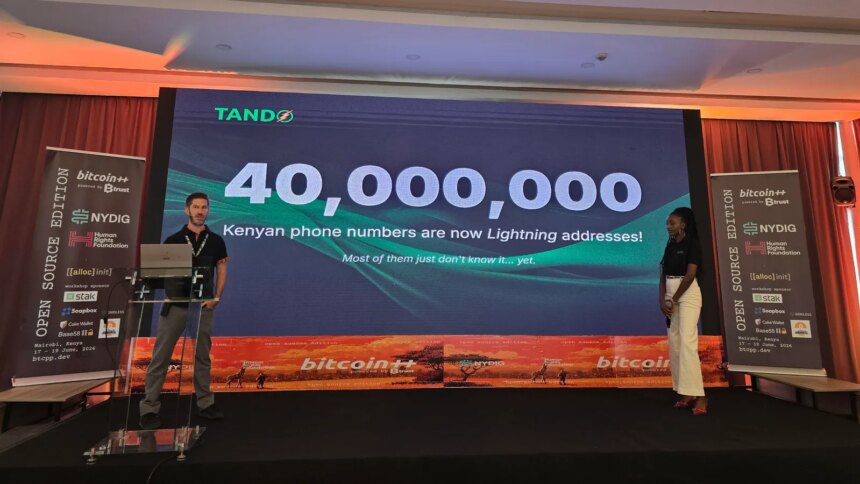
Last month, Tando, a Kenya-based Bitcoin payments company, announced the launch of an innovative service that enables 40 million Kenyans to send and receive Bitcoin seamlessly using the existing M-Pesa mobile money infrastructure. By integrating various technologies and in-house solutions, Tando has positioned Bitcoin’s Lightning Network as a translation layer, significantly enhancing accessibility for users across the country.
Founded in 2024 by Jason and Sabina Waithira Gitau, Tando set out to address a critical issue: enabling Kenyans to transact in Bitcoin as easily as they do with Kenyan Shillings (KES). Their strategy revolved around leveraging M-Pesa, a widely used mobile platform, to facilitate a user-friendly experience. The company developed an app that allows users to pay M-Pesa invoices with Bitcoin, eliminating the necessity for local currency. By simply entering the recipient’s M-Pesa phone number and the payment amount, users receive a lightning invoice, which, upon payment, instantly converts to KES for the recipient.
During a panel discussion at the Oslo Freedom Forum, Gitau highlighted that users can experiment with Tando using amounts less than a dollar, completely free of transaction fees or identity verification, allowing for quick validation and easy adoption.
Despite the positive reception, Gitau noted that users still require a separate Bitcoin wallet to utilize Tando’s services. To address this challenge, the Tando team again leaned on the existing infrastructure, utilizing M-Pesa phone numbers along with lightning addresses, which allow users to receive Bitcoin payments via email-like identifiers. This innovative method was unveiled in May, enabling any Bitcoin wallet supporting lightning addresses to send Bitcoin directly to a Kenyan phone number through M-Pesa. Recipients can claim their funds, set up a non-custodial Bitcoin wallet, and take full advantage of the service.
Tando’s approach draws parallels to the South African initiative Machankura, which allows users to send and receive Bitcoin offline through the Lightning Network utilizing USSD codes. While Tando acknowledges potential privacy concerns associated with linking phone numbers to payment systems, the team is committed to refining their service to strike a balance between usability and privacy.
The rise of Tando aligns with a broader movement across Africa, where various projects focus on embedding Bitcoin as a practical currency rather than a speculative asset. Entities like MavaPay have emerged, concentrated on enhancing utility and promoting the message of ‘spend not sell,’ encouraging users to engage with Bitcoin as a form of money rather than merely a trading instrument.
For Tando, accessibility is key. The team emphasizes that Bitcoin should be available to all, with no barriers or gatekeeping—ensuring equal opportunity for everyone, from government officials to farmers. This accessibility allows users to fully embrace a lifestyle centered around Bitcoin, a concept increasingly referred to as the African way to utilize cryptocurrency.
Recent feedback from attendees at the Bitcoin++ Nairobi conference highlighted the efficacy and simplicity of Tando’s service, with many expressing surprise at the feasibility of living entirely on Bitcoin. As Tando has illustrated, the fusion of mobile money services with Bitcoin underscores the potential for innovation within the African technology landscape, where necessity is driving development. This reflects a growing trend: Africans are actively shaping their financial futures, demonstrating that grassroots initiatives can thrive without waiting for broader adoption or validation.