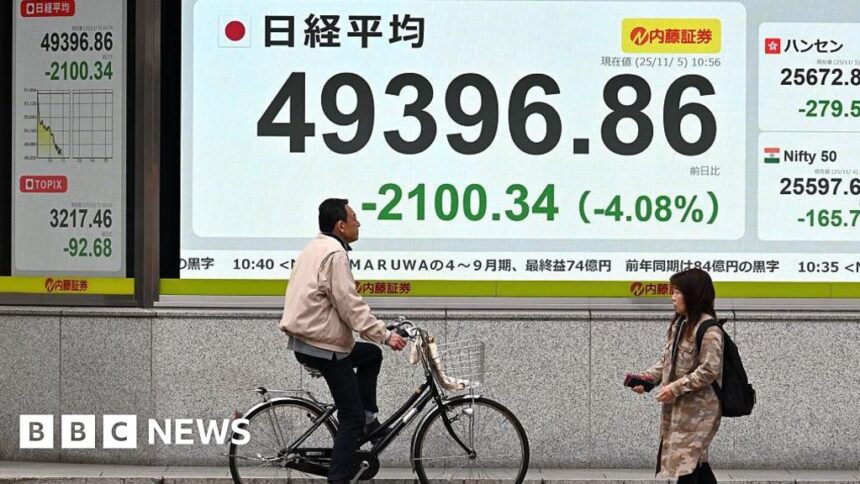
Shares of key technology companies have experienced significant declines as concerns over the valuations of firms associated with the artificial intelligence (AI) industry intensify. This growing unease has given rise to fears of an “AI bubble,” particularly as tech stock valuations reached unprecedented levels earlier this year.
The impact was most acutely felt in Asian markets on Wednesday, which suffered a notable downturn following a sell-off in the United States. Japan’s stock exchange saw a drastic decline of over 3%, primarily driven by significant losses in the tech investment titan, SoftBank, whose shares plummeted more than 10%.
In the U.S., these valuation worries were exacerbated by revelations that prominent trader Michael Burry—known for his role in predicting the 2008 housing market collapse, which was dramatized in the film “The Big Short”—has placed a staggering $1.1 billion bet against the prices of AI-related stocks, including Nvidia and Palantir. Burry’s investment firm has acquired financial instruments, known as options, that will yield returns if the share prices of these AI-linked companies decline. His cautionary note on social media suggested, “Sometimes, we see bubbles. Sometimes, there is something to do about it. Sometimes, the only winning move is not to play.”
As the year progressed, markets worldwide have generally ascended, drawing investor interest towards companies involved in AI, such as Nvidia, Intel, and AMD. However, recent developments indicate a growing skepticism towards the sustainability of this fervor. Financial analyst Farhan Badami noted that “fatigue over AI and the current earnings run has investors questioning the durability of the AI hype,” consequently dragging down the stock values of numerous AI-centric firms.
For example, shares of Amazon, which soared to an all-time high earlier in the week following a substantial $38 billion agreement with OpenAI, experienced a decline of 1.84% on Wednesday. Meanwhile, Nvidia, which recently became the first ever company to boast a valuation of $5 trillion, faced a nearly 4% drop.
SoftBank’s tumble particularly hindered Japan’s Nikkei index, as the firm has invested extensively in AI development, pouring billions into tech companies, including OpenAI and Intel. Analyst Vincent Fernando described SoftBank’s recent stock surge as a “double-edged sword,” highlighting that while it may attract investors, the rapid ascension can render the stock vulnerable to retreats when market sentiments shift.
The downturn was not limited to Japan; technology shares across Asia faced significant losses as well. Samsung in South Korea fell by over 4%, and the country’s composite index, the Kospi, plunged by 2.85%. Semiconductor manufacturer TSMC, vital to Nvidia’s supply chain, also saw its shares decline by nearly 3%.
Looking ahead, Badami from eToro speculated that the correction within tech stocks could persist over the coming year. He remarked that investor concerns over exorbitant valuations are likely to grow, especially given the substantial spending trends among AI-focused firms. Many companies are venturing into costly AI investments without generating sufficient returns to warrant such expenditures, further fueling market anxieties.