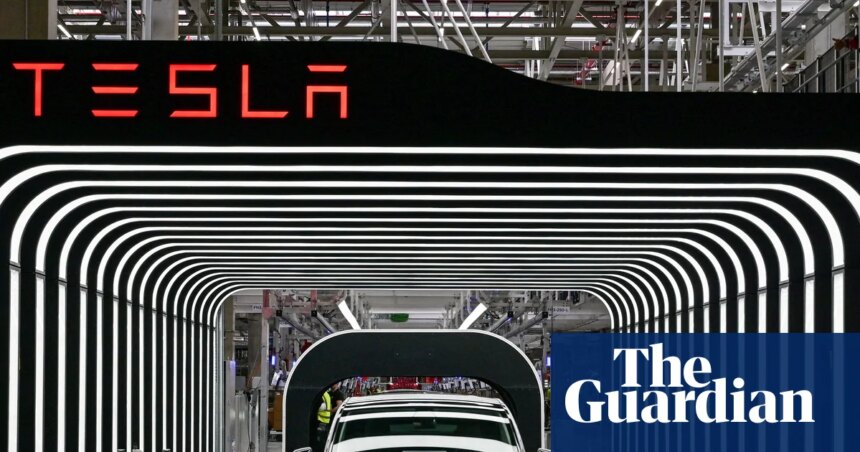
In a surprising move, Tesla has released sales forecasts indicating a potential decline in deliveries for 2025, countering earlier expectations set by CEO Elon Musk. The electric vehicle manufacturer disclosed projections on its investor website, revealing an anticipated 423,000 deliveries in the fourth quarter of 2025. This figure represents a 16% drop compared to the last quarter of 2024.
The broader estimates suggest that Tesla will achieve 1.64 million vehicle deliveries for the entire year of 2025, down from 1.79 million in 2024. Despite a projected uptick to 1.75 million in 2026, deliveries are not expected to reach the ambitious targets Musk had previously outlined, including a goal of producing 4 million vehicles annually by the end of 2027.
Currently, Tesla holds a market valuation of $1.4 trillion, outpacing the collective value of the next thirty car manufacturers, although its production is less than 20% of that of industry leader Toyota. Musk’s wealth, driven by his stakes in Tesla and SpaceX, has positioned him as the world’s richest person, with an estimated fortune of $623 billion.
Tesla’s sky-high valuation largely rests on investor expectations for the company to become a frontrunner in self-driving technology and robotics. However, the automaker has faced challenges this year, partly attributed to a dip in consumer sentiment linked to Musk’s vocal political alignments. His significant contributions to Donald Trump’s election campaign and subsequent attempts to advocate for reduced government spending have stirred mixed reactions among the public and customers. Moreover, the elimination of government incentives for buyers and regulatory rollbacks enacted during Trump’s administration have further complicated Tesla’s sales outlook.
Analysts have noted that the company’s forecasts are lower compared to alternative estimates from investment banks, which project approximately 440,907 vehicle deliveries for the fourth quarter. These variations in expectations carry tangible implications; failure to meet consensus forecasts typically results in declines in share prices, while surpassing them can lead to gains.
Despite Musk’s assertions from a November shareholder meeting that projected drastic production increases, the newfound estimates indicate a slower trajectory toward the targets he had laid out. Tesla shareholders recently approved a substantial $1 trillion compensation plan for Musk, contingent upon achieving a goal of delivering 20 million vehicles, of which 10 million would need to have active subscriptions for its “full self-driving” software for him to receive the payment.
As Tesla navigates these challenges, the market will be closely observing the implications for its investment strategy and long-term goals, particularly in a climate marked by both uncertainty and competition in the rapidly evolving electric vehicle space.