Investors are increasingly grappling with the challenges posed by current stock market conditions, with many hesitating to buy shares in the hopes of more favorable financial climates. Mike Wilson from Morgan Stanley emphasizes the futility of such waiting, noting, “The market waits for no one.” He explains that markets are inherently future-focused, reflecting not today’s realities but rather expectations for what lies ahead amidst uncertainty.
A significant misconception persists among investors—that stock prices should mirror current events. This assumption overlooks the market’s ability to discount existing uncertainties while anticipating the resolution of those challenges and potential economic recovery. While recent volatility has clouded perspectives, tangible improvements in earnings have begun to emerge, contradicting the narrative of a stagnant or bleak market landscape.
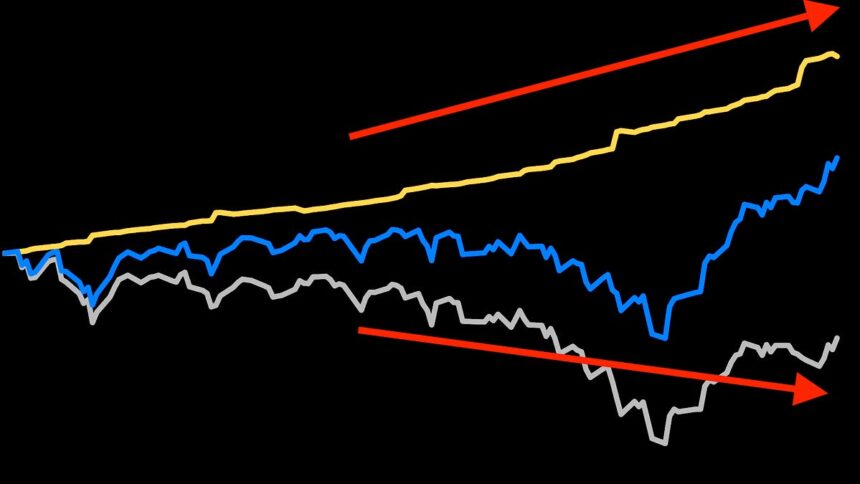
Despite the S&P 500 experiencing a notable dip of 9% earlier this year, Wilson points out that the forward price-to-earnings (P/E) ratio fell 18%. However, despite prices rebounding, current P/E ratios remain lower than in previous periods, indicating that investors are now paying less of a premium for anticipated future earnings. He attributes this trend not to a sense of complacency, but rather to thorough recalibrations in response to risks like geopolitical tensions and economic disruptions.
The upturn in earnings is central to the current valuation paradox. Reported earnings have surpassed expectations, leading to upward revisions in future earnings estimates. As earnings growth outpaces price increases, this dynamic naturally drives down the P/E ratios. Wilson captures this relationship through analytical charts, illustrating how growing earnings are leading to a decline in valuation metrics.
Another critical factor for investors to consider is the passage of time, which historically favors earnings growth. Historical data indicates that S&P 500 earnings have generally trended upward over the past nine decades. Therefore, the longer investors remain sidelined, waiting for cheaper valuations, the more they risk facing higher prices as earnings continue to climb.
Current economic data presents mixed signals but leans toward resilience. For instance, consumer price inflation has recently surged, with the Consumer Price Index rising by 3.8% year-over-year in April, driven primarily by escalating energy costs. Retail sales have also shown signs of strength, increasing 0.5% to reach a record of $757.1 billion in April, alongside rising consumer spending.
Additionally, initial unemployment claims remain relatively low, suggesting ongoing economic strength despite some easing in job growth. On the housing front, previously owned home sales have seen small increases, buoyed by lower mortgage rates compared to a year prior, even though inventory levels remain constrained.
As these dynamics unfold, small business optimism is also on the rise, although it remains cautious due to persistent inflationary pressures. The outlook remains tentative, with potential risks including geopolitical instability, fluctuations in energy prices, and various market uncertainties that could induce short-term volatility.
Overall, while current economic indicators may not paint an entirely optimistic picture, they appear to support an argument for long-term investment strategies focused on anticipated earnings growth. The ongoing adjustment of companies to heightened cost structures and market conditions highlights the essential nature of earnings in driving stock market performance.
As investors navigate these complexities, understanding that stock prices often reflect future expectations rather than current realities may prove vital. Those who may be waiting for “attractive” valuations might find themselves facing steeper prices as earnings climb higher, underscoring the importance of aligning investment strategies with a long-term perspective in the ever-evolving market landscape.