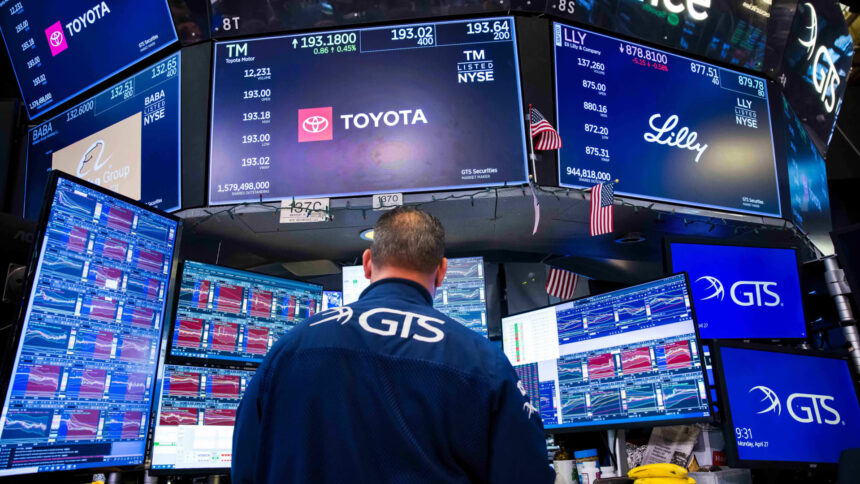
Traders on the New York Stock Exchange are closely monitoring the markets as futures linked to the S&P 500 showed little change on Tuesday night. The anticipation surrounding quarterly earnings reports from four major players in the tech sector – commonly referred to as the “Magnificent Seven” – is adding to the day’s tension. Additionally, the conclusion of what could potentially be Jerome Powell’s final meeting as chair of the Federal Reserve is capturing significant attention.
As of late Tuesday, S&P 500 futures edged up by 0.1%, while Nasdaq 100 futures saw a modest increase of 0.2%. Futures associated with the Dow Jones Industrial Average climbed by 63 points, or approximately 0.1%.
In after-hours trading, notable movements were observed in individual stocks. Starbucks experienced a surge of 5% after it raised its full-year outlook, marking a positive development for the company. Conversely, Robinhood’s shares dropped by 9% after the company’s first-quarter results failed to meet analysts’ expectations. In contrast, both Seagate Technology and NXP Semiconductors surged around 16% after reporting better-than-expected earnings and promising positive revenue forecasts.
In the regular trading session on Tuesday, the S&P 500 and Nasdaq Composite pulled back from their record highs. The S&P 500 fell by 0.49%, the Nasdaq Composite declined by 0.9%, and the Dow Jones Industrial Average lost 25.86 points, equivalent to a 0.05% decrease. The technology sector was particularly affected by losses, largely triggered by a report from The Wall Street Journal indicating that OpenAI did not meet its revenue and user growth targets. Tech giant Oracle, which has a significant partnership with OpenAI worth $300 billion over five years, saw its stock slide by 4%. Other chipmakers, including Broadcom and Nvidia, also experienced declines of 4% and over 1%, respectively.
Looking ahead, investors are eagerly awaiting earnings reports from Alphabet, Amazon, Meta Platforms, and Microsoft, scheduled for release right after Wednesday’s closing bell. There is a strong belief among investors that these companies will need to demonstrate significant revenue gains to justify the hefty capital investments they have made in artificial intelligence technology. Steven Wieting, chief investment strategist at CIO Group, highlighted this sentiment, noting that these four companies increased their full-year capital expenditures by a staggering $94 billion during their last reporting period.
Wednesday will also mark the end of the Fed’s April policy meeting, expected to be significant, particularly as it is likely to be Jerome Powell’s last meeting before the end of his term in May. Analysts predict that the Fed will maintain the current federal funds rate, setting the stage for a transition to Kevin Warsh, who is poised to succeed Powell at the central bank.