U.S. President Donald Trump’s recent decision to demolish the East Wing of the White House has sparked outrage across the country, with many Americans viewing the act as a troubling metaphor for his presidency. The demolition represents a significant departure from tradition, raising concerns about how the role of the presidency is being reshaped under Trump’s leadership. Critics argue that rather than preserving the historical and cultural significance of the White House, Trump is using it as a means to advance personal ambitions, including the creation of a lavish ballroom for elite functions.
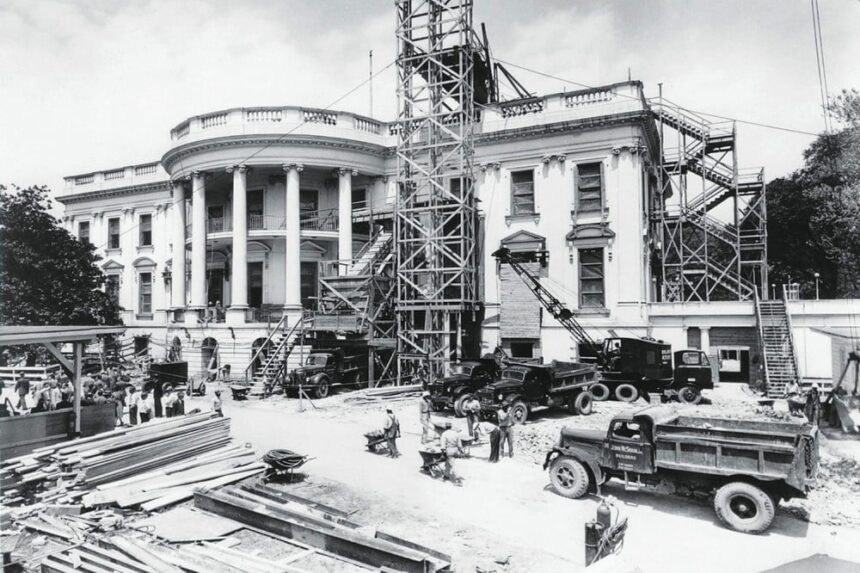
As backlash intensified, Trump defended his actions by highlighting a “proud presidential legacy” of renovation at this historic site. While it’s true that the White House has a long history of renovations, the context and motivations behind these changes differ significantly. For instance, President Harry Truman confronted a dire need for reconstruction in the late 1940s, as the White House was literally falling apart. Issues such as cracked plaster and structural instability prompted Truman to oversee a comprehensive renovation designed to preserve and enhance the building’s historical integrity.
The East Wing was originally built in 1942 during Franklin D. Roosevelt’s presidency, primarily to house an underground bunker for emergency situations. Over the decades, it evolved into a space for hosting visitors and various events, including an indoor swimming pool installed for Roosevelt as part of his polio therapy. In stark contrast to Trump’s current motivations, Truman’s renovation was marked by bipartisan support and a clear focus on the necessity of repairs, rooted in a respect for the building’s historical context.
The renovations led by Truman aimed to modernize the White House without erasing its past. He prioritized preserving historical features, opting to maintain the building’s structural elements while improving functionality, even opting to use materials from the original structure in the rebuild. Truman faced his own critics, particularly concerning the costs and timelines, but there was a broad acknowledgment of the need for the project and a commitment to honoring the historical significance of the White House.
In Trump’s case, however, the recent demolition has raised serious ethical and procedural concerns. There appears to be a lack of justification for the project, and critics are questioning whether traditional oversight mechanisms, like input from the National Capital Planning Commission or the National Trust for Historic Preservation, were ignored. Moreover, the funding for the project reportedly comes from major private donors with vested interests in the administration’s policies, only compounding the unease surrounding the motivations behind the demolition.
Adding a layer of irony, Trump has recently issued an executive order advocating for the restoration of Confederate monuments, which symbolize resistance to civil rights and reconstructed national identity. Yet, he seems willing to dismantle the very building that serves as a cornerstone of American history and democracy, one that has housed presidents from both parties who made crucial decisions impacting the nation’s future.
The difference between the ongoing renovations led by Trump and those of his predecessors is not just a matter of approach, but of intent. Where there was once a commitment to blend modernization with a deep respect for history, the current agenda appears to prioritize personal desires over national heritage. As these developments unfold, the American public remains divided, grappling with the implications of such a transformation at the heart of their government.