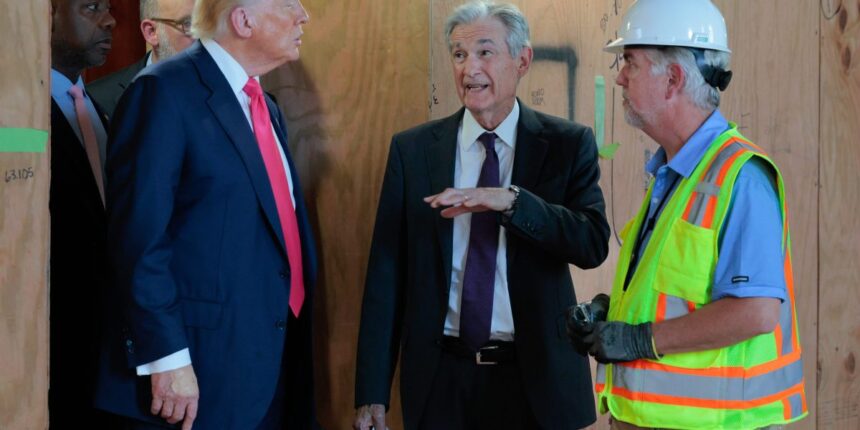
Former President Donald Trump’s frustrations with Federal Reserve Chair Jerome Powell have been reignited following a significant downward revision in U.S. job growth figures. The Bureau of Labor Statistics (BLS) announced a staggering cut of 911,000 jobs since 2024, intensifying Trump’s criticism of the Fed and creating additional political turmoil as the central bank’s September meeting approaches.
For months, Trump has expressed dissatisfaction with Powell, arguing that the Fed has been slow to reduce interest rates. The new jobs report data, which was revised this August—a routine event for the BLS—was notably severe this year. The adjustment indicated that the U.S. had added roughly 911,000 fewer jobs from March 2024 to March 2025 than previously reported, a figure that has shocked economists and market analysts alike. This follows a significant downward adjustment from the BLS in July, which saw job growth for May and June revised down by 258,000.
This recent downturn highlights a broader issue, as the revision has emerged just days before the Fed is set to make crucial decisions concerning interest rates. The new data suggests that the labor market’s slowdown began earlier than previously thought, coinciding with the final stages of President Joe Biden’s administration and during a contentious presidential election where Trump was reelected.
According to Bradley Saunders, an economist with Capital Economics, the broad-based revisions indicate substantial downgrades in various services sectors. The leisure and hospitality sectors saw a decrease of 15,000 jobs per month, while professional and business services and retail trade were down by 13,000 and 10,000 jobs, respectively. Saunders noted that with services being the last stronghold of employment growth, the downward revision raises concerns about the overall health of the labor market.
As the report was released, Trump took to social media platform Truth Social to criticize Powell, asserting that the Fed chair has “done a terrible job” since he adopted a 2% inflation target that Trump deemed too rigid. He expressed a desire for the Fed to use “modern sources of information.”
This critique echoes the investment perspective of Mike Wilson from Morgan Stanley, who argues that a “rolling recession” has affected various sectors of the economy since 2022, suggesting that traditional data analyses might have overlooked this trend. The implications of the jobs revision are significant, altering the narrative surrounding the health of the U.S. labor market over the past year.
The recent August jobs report indicated only 22,000 new positions had been created, largely within healthcare and support services, further raising alarms about stagnating job growth outside of these areas. The impending cuts to Medicaid are expected to exacerbate the situation in October.
As inflation persists alongside weak employment growth, the concerns of “stagflation” loom larger. With consumer prices anticipated to rise for August, pressure mounts on both the Federal Reserve and the Biden administration.
Trump’s campaign is leveraging the revised job figures to cast doubt on Powell’s leadership and the credibility of government statistics. Despite expert assurances that the BLS revisions are standard and apolitical, many Trump supporters argue that the revised numbers reflect deeper systemic issues, potentially hinting at bureaucratic inefficiencies or political manipulation. A Trump ally, Commerce Secretary Howard Lutnick, has gone so far as to assure that a “jobs boom” is on the horizon if a new administration’s investment plans are enacted.
Simultaneously, White House officials are facing heightened scrutiny over an increasingly fragile job market. A recent New York Fed survey revealed that confidence in job opportunities is at its lowest since the survey began in 2013.
Investors on Wall Street are intently focused on the BLS revision and its potential effects on Fed policy. While some anticipate a bold half-point rate cut in the upcoming meeting, market consensus leans toward a more modest 25 basis-point reduction, placing Powell in a challenging position. He must navigate maintaining the Federal Reserve’s credibility while addressing mounting political and economic pressures.
As Trump continues to utilize the labor data in his criticisms of Powell, all eyes are on the forthcoming Fed rate decision and the White House’s response to rising concerns from both workers and investors. The revised job figures not only add complexity to ongoing debates about economic policy but also highlight the intricate interplay of politics and public confidence amid growing economic uncertainty.