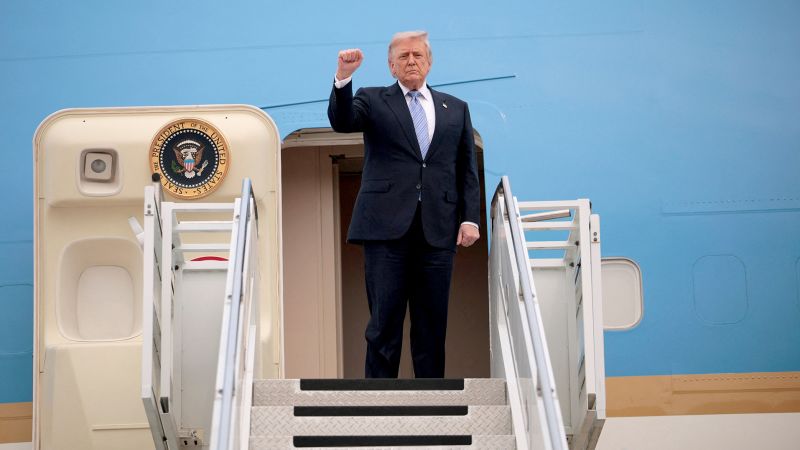
Before concluding a two-day summit in Beijing, President Donald Trump remarked on numerous trade deals made with China, flanked by a group of influential tech billionaires he dubbed “brilliant.” However, upon departure aboard Air Force One, the specifics of those agreements were notably unclear, indicating a potential shift in power dynamics between the world’s two largest economies since Trump’s previous visit nearly nine years ago.
The vagueness surrounding the outcomes of the talks led to a swift reaction in the markets, where investors expressed dissatisfaction. Stocks experienced a sell-off, with Dow futures plummeting over 300 points, or 0.6%. Broader indices mirrored this trend, as the S&P 500 futures fell by 1% and Nasdaq futures dropped by 1.4%. In contrast, Brent crude oil futures surged by 3%, surpassing $108 a barrel, in response to unresolved issues concerning the Strait of Hormuz. Soybean futures also took a hit amid uncertainties about China’s commitment to purchasing U.S. agricultural products. Bond yields rose as traders showed increasing caution towards rising inflation.
This visit marked the first encounter between a U.S. leader and Xi Jinping in the Chinese capital since November 2017. Trump’s trip had initially been scheduled for April but was postponed due to an energy crisis in the wake of his administration’s conflict with Iran.
Arriving in Beijing with a notably weaker position than during past negotiations, Trump faces rising domestic challenges as gas prices and other consumer goods soar, coinciding with plummeting consumer sentiment. Unlike Xi, the Chinese president, Trump is also contending with imminent midterm elections.
On the summit’s closing day, Trump announced that China would acquire 200 Boeing aircraft and showed interest in increasing purchases of U.S. oil, a move driven by disruptions in global supply due to Middle Eastern conflicts. Additionally, he suggested a potential reconsideration of sanctions on Chinese entities engaging in Iranian oil purchases.
U.S. Trade Representative Jamieson Greer relayed expectations of a commitment from China to buy agricultural products valued in the “double-digit billions,” although specific details remained elusive. As of yet, China has yet to corroborate any of the statements made by U.S. officials.
Analysts had tempered expectations for substantial agreements, particularly given the deteriorated U.S.-China relations. The lack of concrete advancements sharply contrasted with Trump’s previous visit in 2017, when nearly 30 U.S. executives accompanied him to Beijing and announced deals worth over $250 billion before his departure, including a promise from China to buy 300 Boeing aircraft that ultimately went unfulfilled.
In this round, only 17 executives traveled with Trump, primarily from tech and finance sectors, including Nvidia CEO Jensen Huang, Apple CEO Tim Cook, and Tesla CEO Elon Musk. Kent Kedl, a Shanghai-based risk advisory expert, noted that the focus for the current delegation seemed to center on gaining access to the Chinese market rather than securing definitive export agreements.
The landscape for these executives has grown increasingly complex, with China’s emphasis on fostering domestic firms intensifying as part of a strategic drive for self-sufficiency. Notably, Nvidia’s Huang has been advocating for U.S. government assistance in selling chips to China, yet domestic preferences for local chipmakers have hindered purchases. Meanwhile, Tesla is struggling to maintain its market position against rivals like BYD, and Apple faces mounting competition from local smartphone manufacturers such as Huawei and Xiaomi.
While discussions about U.S. investments in China were lacking, Treasury Secretary Scott Bessent mentioned potential conversations related to establishing an investment board for non-sensitive Chinese investments in the U.S. However, Trump noted that tariffs were not addressed during his discussions with Xi.
Future agreements may evolve in the days ahead, particularly concerning U.S. agricultural and energy exports. Some analysts suggest that for the summit to be deemed successful among Trump’s rural voter base, China should announce additional multi-year agricultural purchases, including grains and meat, while reaffirming previous commitments regarding soybeans.
Nevertheless, past experiences reveal that any announced agreements could take months—or longer—to come to fruition. Leah Fahy, an economist specializing in China, reminded observers that many projects discussed during Trump’s 2017 visit never materialized, further emphasizing the need for skepticism regarding any announced deals. Ultimately, it appears that China’s economy is less reliant on the U.S. now, reflecting a changing landscape for both nations and their leading enterprises.