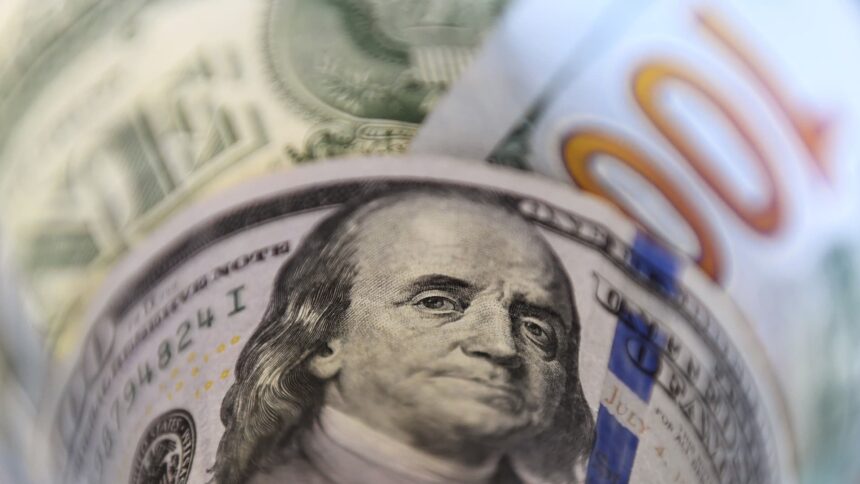
The U.S. dollar experienced a decline on Thursday, impacted by the ongoing Sino-U.S. trade war that has dampened investor sentiment. Additionally, growing expectations surrounding the U.S. Federal Reserve potentially cutting its policy interest rate this year contributed to the weakening of the greenback.
In early trading, the euro increased by 0.14%, reaching a value of $1.1664, marking its highest level in a week. Similarly, the Japanese yen strengthened, climbing to a one-week high of 150.52 per dollar. The dollar index, which gauges the currency against a basket of six others, was down 0.16% at 98.512 and appeared to be on track for a weekly decline of 0.33%.
Investor attention has primarily focused on the escalating trade tensions between the United States and China. U.S. officials criticized China’s recent imposition of export controls on rare earth minerals, labeling it as a threat to global supply chains. In turn, China’s commerce ministry defended these measures, arguing that they were a response to U.S. restrictions on Chinese goods and actions, thereby characterizing U.S. criticisms as hypocritical.
In a potential diplomatic development, U.S. President Donald Trump remains optimistic about meeting Chinese President Xi Jinping in South Korea within the month, as stated by U.S. Treasury Secretary Scott Bessent. According to Vasu Menon, managing director of investment strategy at OCBC, the newly enacted trade measures will take effect in November, after the anticipated Trump-Xi meeting. Menon speculated that if the meeting proceeds, there’s a chance some recent measures could be softened or rescinded, providing a narrative of successful negotiations.
Currently, both countries have adhered to a six-month trade truce that has seen tariff rates remain lower, allowing for the continued flow of rare earth materials. Bessent has indicated the possibility of extending this truce longer than the traditional 90-day increments. Joseph Capurso, head of foreign exchange at the Commonwealth Bank of Australia, suggested that an extension of existing agreements might be a more practical outcome compared to a comprehensive resolution that would address all trade concerns.
In Australia, the dollar fell by 0.4% to $0.6485 following reports that unemployment hit a near four-year high in September, bolstering arguments for potential interest rate cuts. The Australian dollar, often viewed as a barometer for risk appetite, exhibited volatility this week due to persistent trade tensions; traditional safe-haven currencies such as the Swiss franc also experienced a rise, with the franc trading stronger at 0.7952 per U.S. dollar.
As the U.S. government shutdown entered its third week, investors turned their focus to insights from policymakers regarding the future path of the Federal Reserve. Market participants have factored in a projected lowering of interest rates by 48 basis points this year, reflecting heightened confidence in rate cuts during the Fed’s remaining policy meetings of the year. Although recent comments from the Fed indicated that U.S. economic activity remained steady and employment stable, some signs pointed to labor market weaknesses and decreased consumer spending.
Simultaneously, developments in Japanese politics drew attention after the country’s parliament failed to establish a date for a vote on a new prime minister. The ruling Liberal Democratic Party recently selected Sanae Takaichi as its new chief, but her trajectory toward becoming Japan’s first female prime minister has faced complications following the Komeito party’s decision to end their coalition last week. This political uncertainty could weigh on the yen, though external factors have supported demand for safe-haven currencies. Analysts noted that any new prime minister is likely to adopt looser fiscal measures, as there is expected to be little political support for a tightening of policies by the Bank of Japan.