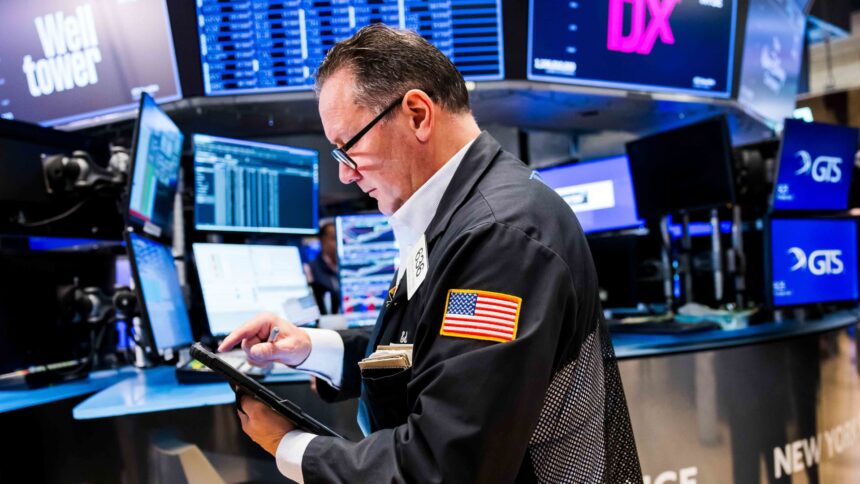
Traders at the New York Stock Exchange witnessed a relatively calm night on Tuesday as U.S. stock futures showed little movement ahead of a crucial inflation report. Both S&P 500 futures and Nasdaq 100 futures dipped approximately 0.1%, while futures associated with the Dow Jones Industrial Average experienced a minor decline of 9 points, marking less than a 0.1% drop.
During the trading session on Tuesday, the S&P 500 and Nasdaq Composite indices retreated from their all-time highs. The S&P 500 saw a decrease of 0.16%, and the tech-heavy Nasdaq dropped by 0.71%. In contrast, the Dow rose modestly, adding 56.09 points, or 0.11%.
Several factors contributed to the downward pressure on stocks, notably losses in the technology sector and rising oil prices. Following recent remarks by former President Donald Trump, who criticized the ongoing ceasefire between the U.S. and Iran as “unbelievably weak” and “on massive life support,” investors faced renewed uncertainty. Trump’s comments came after he labeled a counterproposal from Tehran to conclude hostilities as “unacceptable.” This geopolitical tension, compounded by an unexpected uptick in the annual consumer price index for April, which indicated consumer prices rising at the fastest rate in nearly three years, added to market jitters.
Market participants are now eagerly anticipating the release of additional inflation data, specifically April’s producer price index, scheduled for Wednesday morning. Economists surveyed by Dow Jones forecast a headline increase of 0.5% month-over-month, consistent with the previous month’s rate. When excluding the volatile categories of food and energy, a 0.4% rise is anticipated.
Despite the temporary setbacks in the tech sector, the artificial intelligence investment trend remains a significant motivator in the current market landscape. Olaolu Aganga, head of portfolio construction at Citi Wealth, expressed that the ongoing expansion of AI spending beyond just the tech sector offers investors a plethora of opportunities. “We have global views that we think are lasting and enduring, so energy security and infrastructure — those companies that can benefit from the capex spending with regards to energy and the grid and energy independence,” she noted during an appearance on CNBC’s “Closing Bell: Overtime.”
Aganga emphasized that for those who may have missed out on the recent AI wave, there are still appealing themes in the market that will contribute to durable earnings over time.
Looking ahead, earnings reports from major corporations including Allianz, Birkenstock, Alibaba, and Nebius are set to be released before the market opens on Wednesday, providing further insights into the health of various sectors. Investors remain watchful as these developments unfold, particularly in light of the preceding economic indicators.