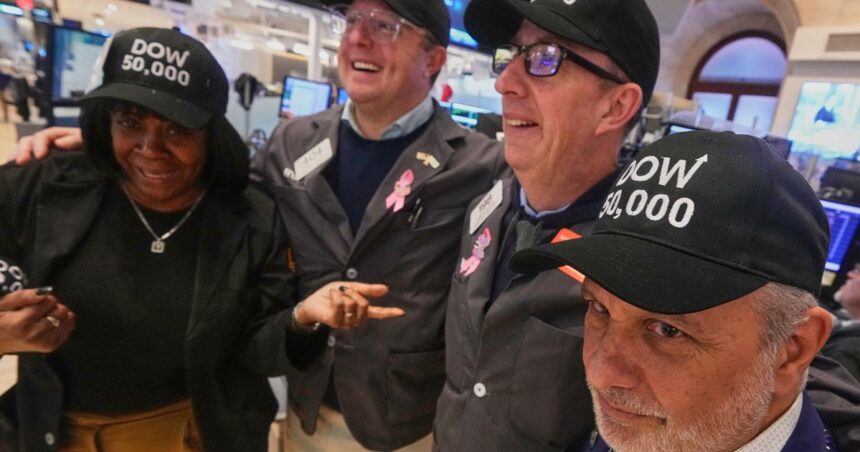
The U.S. stock market experienced a significant rebound on Friday, fueled largely by a resurgence in technology stocks, which had faced considerable declines earlier in the week. The S&P 500 surged by 2%, marking its strongest day since May, while the Dow Jones Industrial Average saw an impressive gain of 1,206 points, or 2.5%, surpassing the 50,000 mark for the first time. The Nasdaq composite also made notable gains, rising by 2.2%.
Key contributors to this rally included chip manufacturers, with Nvidia’s stock climbing 7.8% and Broadcom jumping 7.1%. These gains helped offset previous weekly losses, driven by optimism around ongoing investments in artificial intelligence technology. Amazon’s CEO, Andy Jassy, announced plans for the company to invest approximately $200 billion this year in sectors like AI, robotics, and low earth orbit satellites. However, despite these optimistic projections, Amazon’s stock fell 5.6%, igniting concerns about whether the extensive spending would yield sufficient profits.
Even with Friday’s surge, the S&P 500 recorded its third losing week in the past four, overshadowed by unease around Big Tech spending and fears that AI might siphon off customers from traditional software companies. This concern intensified after AI firm Anthropic introduced free automation tools that could disrupt established services, particularly in legal fields.
In the cryptocurrency market, Bitcoin showed signs of stabilization after a prolonged decline that saw its price plummet more than 50% from its all-time high in October. The cryptocurrency rebounded to over $70,000 after nearing $60,000 late Thursday, helping boost stocks of companies involved in the crypto sector. Robinhood Markets experienced a 14% jump, while Coinbase Global rose 13%, and the strategy firm known for holding Bitcoin surged 26.1%.
Additionally, stocks of smaller U.S. companies gained traction alongside those reliant on U.S. consumer spending, with the Russell 2000 index seeing a 3.6% rise, outperforming the larger S&P 500. Investor sentiment appeared to be improving as indicated by preliminary data from the University of Michigan, which suggested a slight uptick in consumer sentiment, particularly among stockholding households. However, sentiment remained at low levels for those without stock investments.
Airline stocks also benefited from this optimism, with expectations that increased consumer confidence could lead to more travel spending. Notable gains included United Airlines at 9.3%, Delta Air Lines increasing by 8%, and American Airlines rising by 7.6%.
On the broader market front, the S&P 500 gained 133.90 points to close at 6,932.30, the Dow Jones Industrial Average rose 1,206.95 to finish at 50,115.67, and the Nasdaq composite climbed 490.63 to end at 23,031.21.
Internationally, stock indexes across Europe saw positive movement despite Stellantis, the auto manufacturer, announcing a significant write-down of 22 billion euros (approximately $26 billion) due to a reevaluation of its electric vehicle production plans. Conversely, while most Asian markets declined, Japan’s Nikkei 225 index rose 0.8%, bolstered by a 2% increase in Toyota Motor stock ahead of a leadership change.
In the bond market, Treasury yields remained relatively stable, with the yield on the 10-year Treasury edging down slightly to 4.20% from 4.21% late Thursday.