U.S. stocks faced a notable decline as investors reacted to projections from the Federal Reserve indicating that nearly half of its policymakers anticipate at least one interest rate hike this year. The S&P 500 fell by 1.2%, wiping out earlier modest gains. The Dow Jones Industrial Average experienced a dramatic turnaround, shifting from a morning increase of 0.5% to a loss of 1%, while the Nasdaq composite decreased by 1.3%. This reaction was further compounded by rising Treasury yields, fueled by expectations of a potential rate increase by 2026.
In more detail, the Fed’s latest projections revealed that nine out of 18 policymakers are in favor of raising the main interest rate at least once this calendar year. Such increases can curb inflation but often come with the side effect of slowing economic growth and negatively affecting investment prices. The Fed decided to hold the federal funds rate steady at its current level during this meeting, a stance it has maintained throughout the year.
Significantly, during his inaugural press conference, Fed Chairman Kevin Warsh did not provide projections for the federal funds rate beyond 2026. Warsh indicated that he is contemplating a revamp of the Fed’s communication strategy, emphasizing a move away from “forward guidance” that hints at future interest rate changes. Instead, he aims for Wall Street to evaluate incoming economic data independently, assessing its impact on markets without directly linking these evaluations to the Fed’s anticipated actions.
In the bond market, rising yields were evident. The 10-year Treasury yield climbed to 4.48%, while the two-year yield surged even higher to 4.20%. These high yields, driven by inflation concerns globally, pose challenges to economic growth and investment valuations.
In the equity markets, notable fluctuations were evident. SpaceX, following a promising market debut, fell by 3.3%, signaling potential troubles ahead for the company. Conversely, La-Z-Boy saw a sizable increase of 15.2%, driven by stronger-than-expected profits and revenue from newly opened stores, even as the company’s CFO mentioned a cautious outlook regarding broader sales trends.
A report indicated that retail revenues surged faster than anticipated in May, providing a glimmer of hope that robust consumer spending could support economic stability, despite ongoing inflation concerns causing consumer apprehension about financial health.
On the oil front, prices steadied following a tumultuous week, buoyed by optimism surrounding a potential U.S.-Iran deal aimed at restoring oil flow through the Strait of Hormuz. Brent crude oil prices rose by 0.7% to $79.55 a barrel, remaining elevated compared to pre-war levels, yet still below recent peaks of over $100.
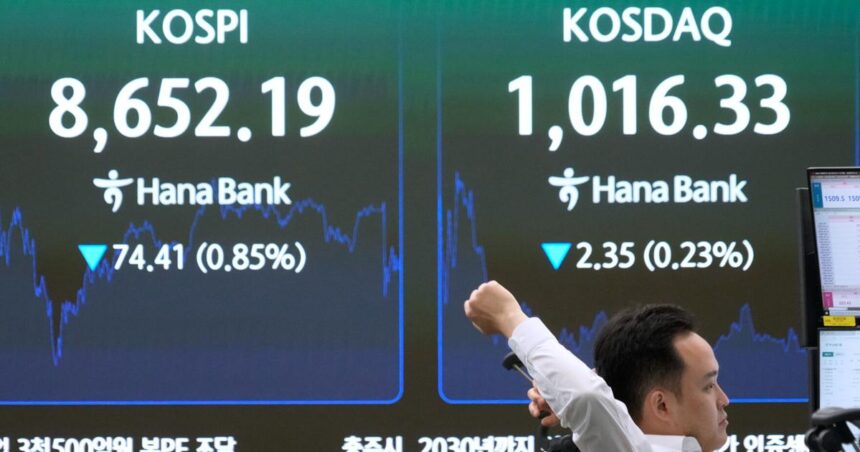
In global markets, reactions were mixed, with London’s FTSE 100 edging up by 0.1% in response to stable U.K. inflation figures. Meanwhile, South Korea’s Kospi surged by 1.6%, while Hong Kong’s Hang Seng index recorded a decline of 0.7%.