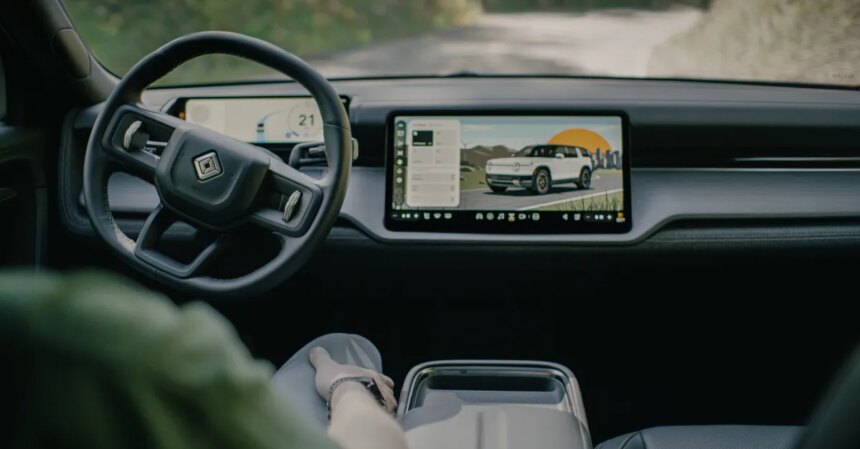
Uber and Rivian have announced a groundbreaking partnership aimed at deploying 50,000 fully autonomous robotaxis over the coming decades. This collaboration, which was revealed Thursday, will see Uber invest a total of $1.25 billion in Rivian through 2031, contingent upon Rivian achieving specific autonomy milestones. The agreement starts with an initial payment of $300 million upon signing, but it’s important to note that the deal still requires regulatory approval.
This initiative represents a significant endorsement of Rivian’s early-stage efforts in autonomy, which include developing custom AI chips designed to power Level 4 autonomous vehicles. Uber has been actively pursuing partnerships in the robotaxi sector, engaging with a range of companies worldwide to leverage its extensive customer base that numbers in the hundreds of millions.
The partnership will kick off with the deployment of 10,000 autonomous R2 vehicles in cities such as San Francisco and Miami by 2028. Following this initial phase, the duo plans to expand the fleet to an additional 25 cities by 2031, with the autonomous robotaxi service available exclusively through the Uber app.
This agreement bears similarities to a previous deal Uber struck with Lucid last summer, which also involved an initial investment of $300 million and the promise of thousands of robotaxis. This raises the question of whether Rivian CEO RJ Scaringe was inspired by the earlier partnership.
However, Rivian’s autonomous capabilities remain largely theoretical at this stage. The company has not yet delivered or publicly showcased most of the features it has announced. Last year, Rivian introduced its Universal Hands-Free driving feature, which has been implemented on about 3.1 million miles of road across the U.S. and Canada. This feature is set to become available for its second-generation R1 vehicles via a software update in December 2025. Later this year, the company anticipates rolling out point-to-point hands-free driving capabilities, which will manage navigation through turns, intersections, and on/off-ramps. Additionally, Rivian intends to incorporate lidar sensors, essential for Level 4 autonomy, into its R2 vehicles by 2026.
If Rivian meets all the agreed-upon milestones, the companies estimate they could deploy “thousands of unsupervised Rivian R2 robotaxis” across 25 cities in the U.S., Canada, and Europe by the end of 2031. The potential inclusion of Europe is noteworthy, as Rivian has not yet established a market presence outside of North America. Additionally, the partnership includes the option for Uber to negotiate the purchase of up to 40,000 more autonomous vehicles beginning in 2030, potentially bringing the total to 50,000.
This investment from Uber comes at a critical time for Rivian as it begins the initial production phase for the R2. At the start of the year, Rivian reported having approximately $6 billion in cash reserves, including $1 billion from its partnership with Volkswagen. However, it is expected to spend upwards of $2.5 billion this year alone to ramp up production of the R2. The initial $300 million infusion from Uber will help ease some of the financial pressure, though not significantly.
On Uber’s end, the company faces its own set of challenges as it establishes alliances with a myriad of players, including autonomous startups like Motional, Nuro, and Wayve, as well as established automakers such as Lucid and Volkswagen. Uber aims to position itself as the leading network for robotaxi services, offering various incentives such as fleet management services and access to training data for potential partners.
Nonetheless, Uber must address questions regarding its long-term relevance and the sustainability of income for millions of drivers as autonomous vehicles increasingly take to the streets.