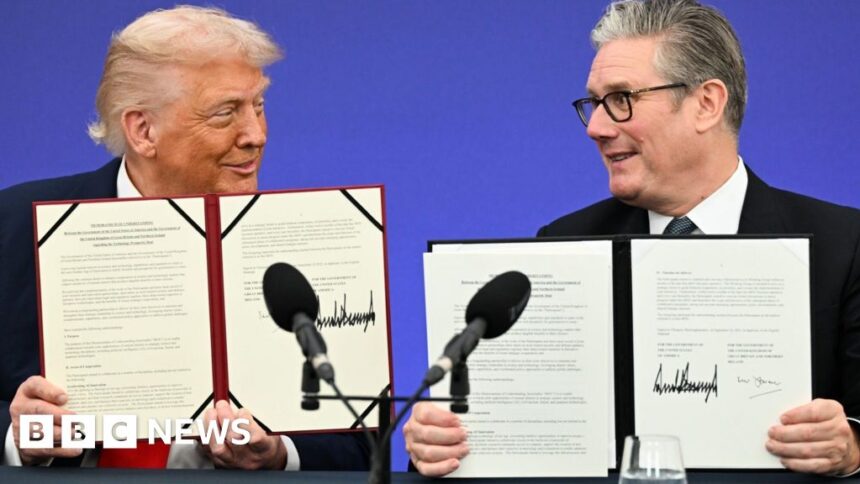
In a significant display of transatlantic collaboration, the Tech Prosperity Deal was signed this week, further aligning the UK with the pro-technology approach of the US administration. The event, held in the historic Camden Town Hall opposite St Pancras station in London, stood in contrast to the royal pageantry at Windsor Castle. It prominently featured a video showcasing the rich history of British science, spotlighting figures such as George Stephenson and Alan Turing, alongside a showcase of burgeoning UK tech startups. Notably, this video was narrated by Jensen Huang, the CEO of Nvidia, signaling a deep commitment to investing in the UK.
Nvidia’s substantial presence was underscored by Huang’s announcement of a £2 billion investment, alongside a passionate endorsement of UK entrepreneurs. During the gathering, which included UK Prime Minister Sir Keir Starmer and members of both British and US cabinets, Howard Lutnick, the US Commerce Secretary, emphasized the US’s desire for mutual success, saying, “We want to win, we want you to win.”
This alliance saw substantial investments pouring into the UK from major American tech companies, including Nvidia, Microsoft, and Google, marking a significant early victory for the UK government’s economic strategy. Microsoft’s commitment to a £22 billion investment aims to bolster AI infrastructure, a move hailed by CEO Satya Nadella as pivotal for AI’s evolution into a general-purpose technology. Meanwhile, Google celebrated a £5 billion investment related to its new data center in Essex and DeepMind, the renowned AI research firm.
Despite the enthusiasm from US tech giants, a sense of skepticism lingered within the UK. Sir Nick Clegg, a former Deputy Prime Minister and senior executive at Facebook, criticized the reliance on US investment, suggesting that the UK was merely “clinging on to the coattails of Uncle Sam” and receiving “crumbs from the Silicon Valley table.” His remarks highlight concerns about the UK’s dependence on American technology and talent.
While the Tech Prosperity Deal did not entail explicit agreements regarding digital taxation or the online safety bill, it showcased a soft alignment with US policies, particularly concerning AI regulation. Lutnick mentioned the abandonment of Biden-era AI safety protocols in favor of a more aggressive approach, a shift mirrored by the UK government.
The overall valuation of the three US tech giants that invested heavily in the UK now stands at $9 trillion, reflecting their readiness to invest in British innovation. The UK tech scene is seen as a potential beneficiary, with hopes of positioning itself as a leading player in the global AI landscape. This aligns with a vision of establishing a technological hub in the region spanning Oxford, Cambridge, and London, which some suggest will benefit from US investment.
However, concerns about the outflow of British tech talent and ideas remain vital. High-profile cases such as DeepMind’s 2014 acquisition by Google for £400 million exemplify the challenges of sustaining homegrown technology giants. Chip designer Arm Holdings, which has been sold to foreign interests, might signify a shift in strategy as indications arise of its potential return to chip manufacturing for better supply chain security.
While past governmental efforts laid the groundwork for current initiatives, the present environment reflects a more aggressive approach towards attracting US investment. The increased flow of US capital is viewed as a safer option for investment compared to other European alternatives.
The long-term consequences of this developing relationship could make the UK a global tech laboratory, primarily serving US interests. Concurrently, both nations are positioning themselves in a long-term tech contest, particularly in the AI domain against China. Despite immediate financial challenges facing the UK, this influx of investment creates a semblance of optimism and potential for technological advancement.
With the UK fully embracing AI, the nation will inevitably grow more intertwined with US tech giants, which, in turn, require British expertise. This burgeoning relationship could significantly reshape the UK economy and societal landscape in the decades to come.