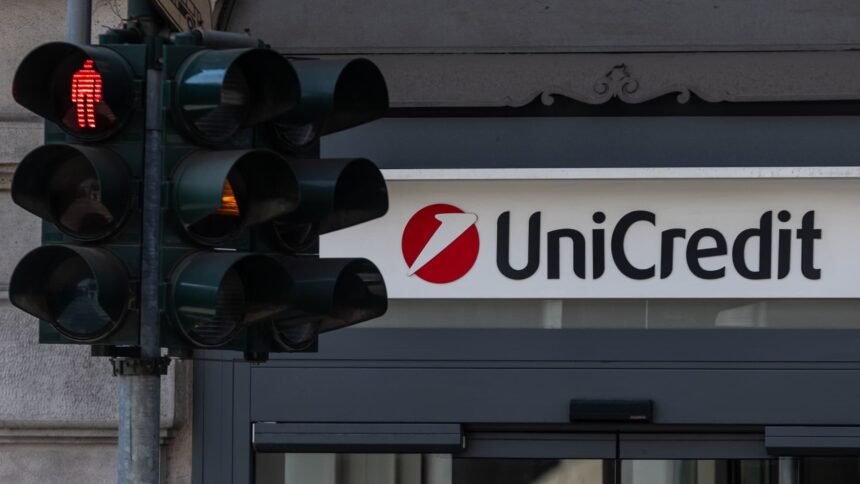
UniCredit has announced ambitious plans aimed at transforming Commerzbank, the German lender it has been eyeing as a potential takeover target. During a conference call, Chief Executive Andrea Orcel emphasized the goal of creating a “country leader and benchmark” through a “true combination” of the two banks, positioning the merger as a move towards establishing a “federal pan-European group and European benchmark.”
Since acquiring a 9% stake in Commerzbank in 2024, UniCredit’s interest has intensified, leading to a current holding that exceeds the 30% threshold necessitating a mandatory full takeover offer under German financial regulations. Despite this, Commerzbank has consistently voiced its preference for maintaining independence, focusing instead on “profitable growth”.
Market reactions saw Commerzbank shares increase by 0.8% in London as of 10:30 a.m. local time, while UniCredit experienced a decline of 2.2% in morning trading. Orcel articulated that the merger would combine two “highly complementary” institutions, highlighting the potential for generating “significant cross-border value” and investment capabilities that could yield around 1.1 billion euros ($1.2 billion) by 2030.
Orcel pointed out that Commerzbank has struggled in recent years, inferring that its current strategy, which is tilted towards growth outside core markets, could lead to continued underperformance through 2028. He criticized the bank’s existing approach for its vulnerability to changing macroeconomic conditions and lack of emphasis on technological and AI investments. “A new chapter,” he proposed, would involve refocusing Commerzbank on its primary markets of Germany and Poland, aligning with UniCredit’s “Unlocked” proposal which projects a net profit increase of 600 million euros by 2028, thereby lifting it to approximately 5.1 billion euros ($6 billion).
Orcel outlined two potential strategies for the bid: one where UniCredit remains a minority shareholder and another where it gains full control. In the latter case, Commerzbank would remain “completely separate and distinct” for an initial 18 months to ensure necessary alignments. A subsequent “Combination” scenario could merge Commerzbank with UniCredit’s HypoVereinsbank, aiming for alignment with the superior performance of that institution.
In a statement, UniCredit contended that Commerzbank is “insufficiently prepared for future challenges” and overly focused on short-term results. Commerzbank countered earlier discussions, asserting there was “no basis for a mutually agreed value-accretive transaction,” and criticized UniCredit for not demonstrating sufficient value creation for its shareholders beyond what it could achieve independently. The ongoing dialogue signals a critical juncture for both banks as they navigate their respective futures in an evolving banking landscape.