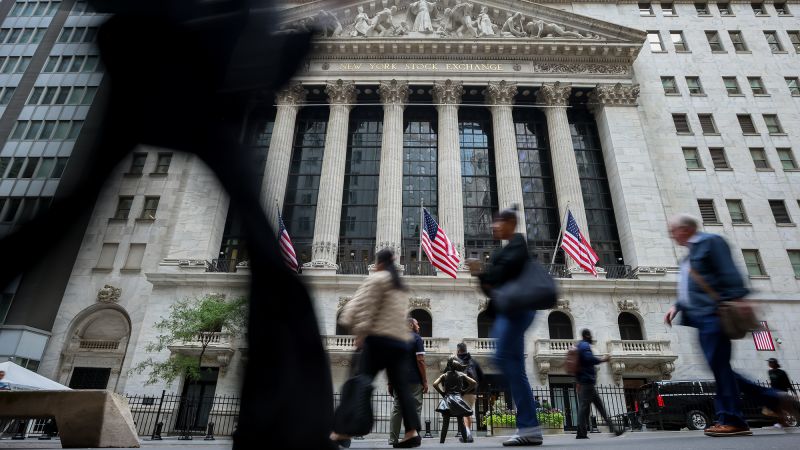
One year after President Donald Trump’s reelection, the US stock market has continued to reach unprecedented heights. The S&P 500 has experienced a remarkable increase of 19.6% in the past year, driven by robust corporate earnings and a significant surge in investor interest surrounding artificial intelligence initiatives. This upward trend in stocks has defied mounting concerns regarding potential global trade tensions and episodes of market volatility.
In a recent speech delivered alongside Japanese Prime Minister Sanae Takaichi, President Trump lauded the stock market’s achievements. “Their stock market today and our stock market today hit an all-time high,” he proclaimed, attributing the gains to his administration’s policies. Despite his assertions, analysts suggest that the market’s rise can be better explained by substantial corporate performance and a bullish attitude toward AI technologies.
According to Jed Ellerbroek, a portfolio manager at Argent Capital Management, the market’s response has been surprisingly positive, especially given the uncertainties introduced by Trump’s aggressive tariff strategies and his considerable influence on the Federal Reserve to lower interest rates. Ellerbroek noted, “The market hates uncertainty,” indicating that investors have largely focused on the profitability of corporations while looking beyond tariff fears. The prevailing sentiment is that the ongoing AI investment cycle, which he described as “humongous and unprecedented,” is overshadowing potential risks.
The S&P 500, which is weighted by market capitalization, has increasingly become dominated by major technology players. Notably, Nvidia has recently achieved a market valuation of $5 trillion, representing approximately 8% of the S&P 500’s total market value. In contrast, an equal-weighted version of the S&P 500 has seen a modest rise of only 6% in the same period, showcasing the disparity in performance among different sectors.
Earlier in the year, fears surrounding tariff implementations led to a significant decline in the S&P 500, with the index falling by as much as 19% in April. However, as the administration revised its most contentious proposals, the market began a sustained recovery, marking six consecutive months of increases.
Mark Malek, Chief Investment Officer at Siebert Financial, noted the role of less severe tariff actions in underpinning stock performance, suggesting that without the initial tariff-induced downturn, the market’s current levels could be even higher.
Broadly speaking, the Treasury market has also seen advances despite apprehensions regarding the US national deficit. Treasury Secretary Scott Bessent has been vocal about the importance of balancing America-first policies with market stability. He remarked, “What gets the people in trouble is they come in, they have these ideas, but they don’t respect the market.”
Since Trump’s reelection, investor optimism has been buoyed by expectations of deregulation and tax cuts, combined with recent interest rate reductions by the Federal Reserve. Ross Mayfield, an investment strategist at Baird, expressed that the rising stock market did not come as a surprise, attributing it to the administration’s fulfillment of investor-friendly policies.
The S&P 500’s performance over the past year has been one of the strongest in presidential history since World War II. However, its gains remain modest in comparison to various global markets, with South Korea’s Kospi index soaring 66%, Hong Kong’s Hang Seng index rising by 28%, and significant increases observed in Poland and Greece.
Highlighting the broader economic context, Keith Lerner, chief market strategist at Truist, emphasized that while Washington’s actions are significant, they are not the sole determinant of market performance. “The North Star of this bull market is corporate profits,” he concluded, underscoring the critical role of corporate earnings in sustaining the current market momentum.