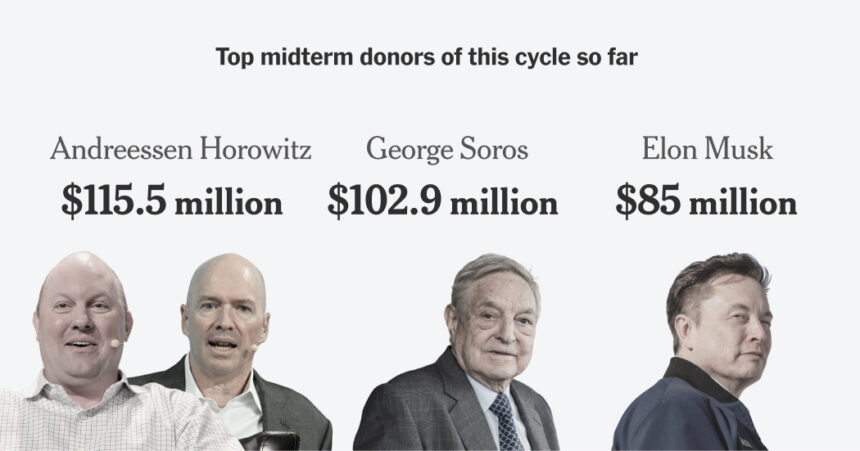
In a surprising turn of events, the largest donor in the current midterm elections is not a billionaire like Elon Musk or George Soros, but rather a venture capital firm, Andreessen Horowitz. This Silicon Valley powerhouse, led by founders Marc Andreessen and Ben Horowitz, has contributed over $115 million in disclosed federal contributions, according to a recent analysis by The New York Times, marking them as the biggest known spenders in this election cycle.
Andreessen Horowitz is no stranger to the political arena. Established in 2009, the firm has a history of hefty political donations, increasing its contributions significantly from the roughly $63 million spent during the previous election cycle in 2024. The firm’s involvement became particularly notable after the 2024 elections; just a day after the polls closed, it funneled more than $23 million into major super PACs supporting the cryptocurrency industry, showcasing its intent to shape long-term political outcomes.
Despite their sizable contributions, the firm has refrained from public commentary, and neither Andreessen nor Horowitz has taken part in interviews about their political strategies. In an election recap podcast, Andreessen expressed the firm’s commitment to remain politically active, suggesting that it aims to play a permanent role in shaping policies, particularly in sectors that impact their investments.
The firm’s spending patterns reflect a significant shift in political donations, where corporate entities like Andreessen Horowitz are outpacing individual billionaires in contributions. Notably, they allocated $47.5 million to the cryptocurrency super PAC network Fairshake and contributed an additional $50 million to Leading the Future, a pro-AI super PAC, indicating a strategic interest that goes beyond cryptocurrency. Both PACs support candidates from both sides of the aisle, further illustrating the firm’s bipartisan approach.
Andreessen Horowitz’s political maneuvering has led to a tighter relationship with the Trump administration. Andreessen has actively participated in the transition team before Trump took office and has had informal roles advising the government on efficiency and technological regulation.
The firm has also been strategic in its contributions to President Trump’s super PAC, MAGA Inc., dedicating $12 million to bolster Trump’s political endeavors, alongside significant donations to the Republican National Committee. This extensive political engagement aligns with Andreessen’s known advocacy for tech and innovation-friendly policies, stemming from a history of political fundraising and connections that date back to the 1990s.
However, this increasing involvement in the political domain has not been without challenges. Internally, dissent emerged when one of the firm’s partners, John O’Farrell, resigned due to differing political viewpoints, criticizing what he called “eager tech enablers” of current regimes. Externally, progressive factions have raised alarm bells, questioning the ethics of a corporate entity wielding such influence over electoral processes.
Critics, including Democratic politicians, have targeted figures like Senator Ruben Gallego for aligning with Andreessen, citing concerns over the implications of such financial backing on democratic integrity. Notably, the firm’s support for Leading the Future has drawn fire, sparking the creation of its competing PAC, Public First, underscoring the contentious dynamics at play regarding AI policy and political funding.
While some Republicans express frustration with Andreessen Horowitz’s emphasis on bipartisanship when their political interests may align more favorably with the Republican Party, the firm has asserted that decision-making power within these PACs is limited. Their chosen political strategy and lobbying efforts are spearheaded by Collin McCune, a Republican consultant, ensuring the firm’s political engagements are strategically managed.
Despite the backlash and mixed reactions to their political strategies, Andreessen Horowitz has made it clear that it intends to leverage its substantial financial resources to influence and engage in shaping political discourse around technology and innovation—a sector they view as critical to their business interests. As Marc Andreessen once remarked, the scale and impact of money in politics are only beginning to be realized, hinting at an ongoing and evolving landscape of corporate influence in electoral politics.