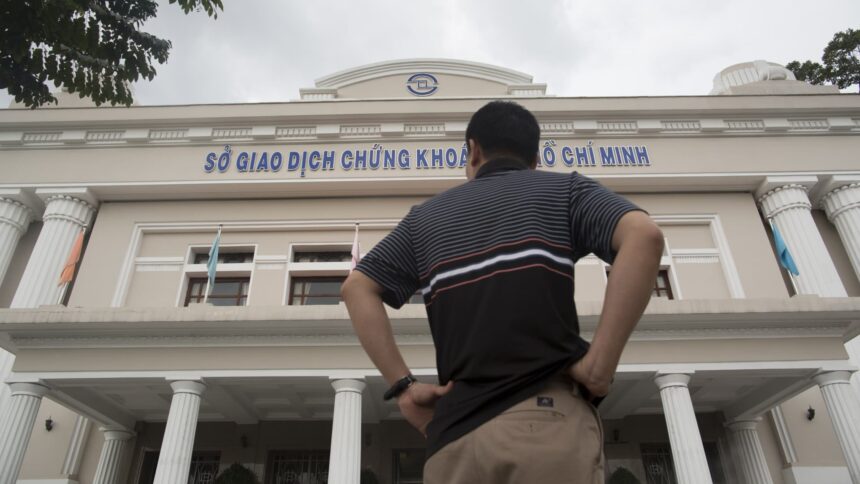
Vietnam is emerging as a formidable player in Southeast Asia, gaining attention for its significant stock market growth, comprehensive domestic reforms, and strategic trade developments. In 2025, the VanEck Vietnam ETF (VNM) has skyrocketed by approximately 62%, vastly outperforming the iShares MSCI China ETF (MCHI), which has seen a growth of nearly 31%. Notably, Vietnam’s market performance eclipses that of other emerging economies, with the VNM achieving year-to-date gains that are more than double the roughly 30% increase of the iShares MSCI Emerging Markets ETF (EEM). The country’s domestic benchmark, the VN Index, has also seen a remarkable 38% rise this year.
The investment landscape in Vietnam is shifting as domestic retail investors drive market activity, creating a climate of increasing liquidity. The average daily trading value has reportedly reached $2 billion at times this year, showcasing a market that is becoming less reliant on foreign investment. Thea Jamison, managing director at Change Global, elaborated on this transformation by stating, “Foreigners have completely missed out on this rally. It’s really growing on its own merit by its own investor base.”
The sentiment surrounding Vietnam’s economic potential was further bolstered by FTSE Russell’s announcement to upgrade the country’s status from frontier market to secondary emerging market, effective September 2026. This change follows a series of reforms, such as the removal of the prefunding requirement for foreign investors. Thu Nguyen, managing director at VinaCapital, predicts that this upgrade could attract an additional $5 billion to $6 billion in capital inflows.
While the VN Index has demonstrated impressive performance, Nguyen notes that its gains have primarily been driven by the real estate sector. If we exclude the major players like Vingroup, Vinhomes, and Vincom Retail, the index’s growth would diminish to roughly 10%. Nevertheless, Nguyen remains optimistic about the stock market’s trajectory, predicting a stable environment in 2026 and corporate earnings growth of around 15%, which could translate into stock market returns ranging from 15% to 20%.
To nurture its economic environment, the Vietnamese government has recently implemented structural reforms aimed at enhancing business operations. A key initiative, Resolution 68, focuses on incentivizing the private sector by reducing bureaucratic hurdles and improving capital access. Additionally, amendments to the Land Law, which took effect in 2024, aim to streamline land acquisition for investors, facilitating real estate and infrastructure developments.
Vietnam’s economic narrative has deep roots, dating back to the landmark “doi moi” policies initiated in 1986, which laid the groundwork for significant growth in subsequent decades. The normalization of trade relations with the U.S. in the mid-1990s and the country’s accession to the World Trade Organization in 2007 were pivotal moments that catalyzed its economic transformation. According to Dan Kritenbrink, partner at The Asia Group and a former U.S. ambassador to Vietnam, the country’s remarkable growth story stands out in Southeast Asia.
Foreign direct investment in Vietnam has also surged, with $21.3 billion reported during the first ten months of the year, marking the highest level for that period in the last five years. Jamison expressed her enthusiasm about the economic momentum, stating, “The cranes are working. This economy is on fire.”
Vietnam’s young and adaptable labor force is an essential factor that sets it apart from other emerging markets. With a strong willingness to engage in manufacturing and services, combined with ongoing investments in education and vocational training, the country is well-positioned to integrate into global production networks.
In terms of trade, Vietnam is actively pursuing diversification of its relationships, especially in light of previous tariff escalations between the U.S. and China. The country successfully negotiated a trade deal with the U.S. earlier this year, which includes a reduced tariff rate of 20% on Vietnamese imports, down from an initial 46%. This agreement enhances Vietnam’s competitive edge in the region, making it an attractive option for foreign investors.
Despite the positive outlook, external factors such as geopolitical tensions, particularly in U.S.-China relations, could pose challenges. Concerns over persistent foreign outflows and currency devaluation may also temper investor enthusiasm.
For U.S. investors looking to gain exposure to Vietnam’s burgeoning market, the VNM provides a viable avenue, charging a fee of 0.68% with more than $580 million in assets. As Vietnam continues its journey toward enhanced economic stature, it is clear that the country is founded on robust reforms and an eager workforce, making it a standout player in the global market.