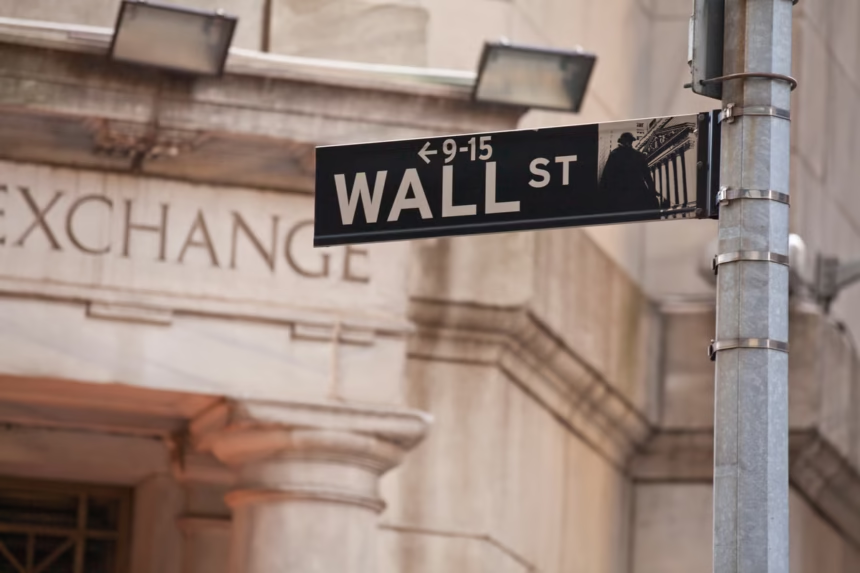
The market landscape has recently undergone a notable shift, yet the trajectory of the S&P 500 at the year’s end remains uncertain. Wall Street’s response to global events, particularly the escalating conflict in Iran, has prompted a reevaluation of stock price targets, with many analysts adjusting their expectations downward.
Prominent financial institutions like JPMorgan Chase and Wells Fargo have joined the fray, cutting their forecasts significantly. JPMorgan hinted that the ongoing conflict may limit potential gains, while Wells Fargo revised its target from 7,800 to 7,300 within a matter of days. This trend of slashing price targets has been echoed by several other firms, reflecting a cautious sentiment amidst rising oil prices and declining consumer confidence, both of which are anticipated to have profound effects on market performance this year.
Analyzing Wall Street’s historical forecasting accuracy reveals a consistent pattern of underestimation. A look at the closing figures for the S&P 500 over recent years illustrates this trend:
- 2020: Consensus target of ~3,300 with an actual close of 3,756, a difference of 14%.
- 2021: Target of ~4,100, closed at 4,766, overestimating by 16%.
- 2022: The year that diverged from the trend, with expected targets of ~4,950 and an actual close of 3,840, marking a difference of (22%).
- 2023: Projected at ~4,050, yet closing at 4,770, a difference of 18%.
- 2024: Initial estimates were ~4,720, closing at 5,881, surpassing projections by 25%.
- 2025: Estimated at 6,600, the actual close was 6,846, yielding a 4% discrepancy.
This historical data underscores a noteworthy trend: in five out of the past six years, Wall Street has underestimated the S&P 500’s end-of-year performance, sometimes by as much as 30%. The exceptions have typically emerged during bear markets, such as in 2022, when an unanticipated rise in interest rates caught many by surprise.
Looking ahead, the potential scenario for 2026 mirrors the tumultuous period of April 2025 when markets faced turbulent conditions due to the imposition of significant tariffs under the Trump administration. However, this time, the economic landscape, influenced by geopolitical developments, could be more precarious. Even if diplomatic negotiations yield positive results, the repercussions on oil and natural gas supply through critical chokepoints like the Strait of Hormuz could linger. The destruction of essential infrastructure and a likely spike in shipping rates can cast a long shadow over market recovery efforts.
If unresolved conflicts lead to prolonged disruptions, the risk of a global recession looms large. While current predictions warrant a measured approach, there remains a historical context reminding investors that those who remain steadfast generally experience favorable outcomes in the long run.
Ultimately, the wisdom for those without foresight into market fluctuations lies in time in the market, which has historically outperformed attempts to time the market effectively. Over the long haul, patience tends to be a more rewarding strategy for investors navigating uncertain terrain.