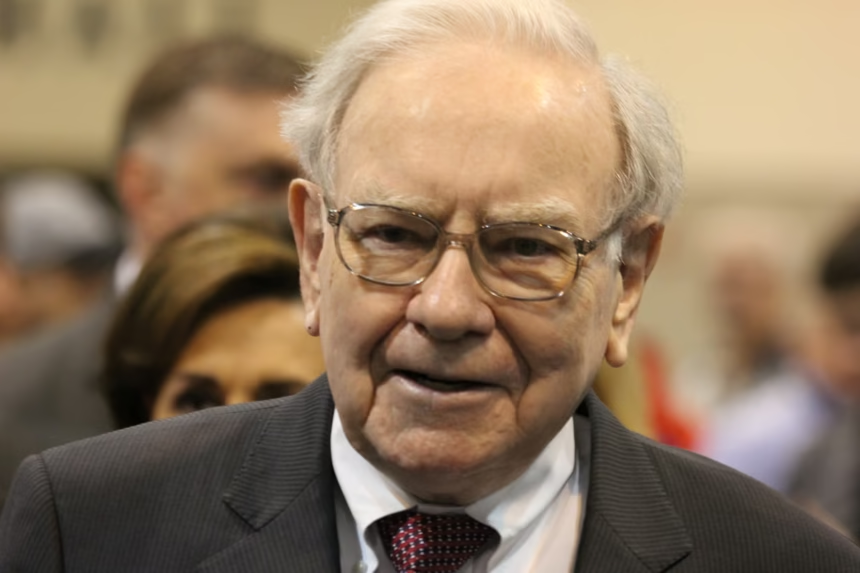
Investing wisely can profoundly change one’s financial landscape, offering paths to long-term wealth and stability. Renowned investor Warren Buffett has emphasized the simplicity of building a strong portfolio, especially for everyday investors seeking greater returns in the stock market. During Berkshire Hathaway’s 2020 shareholder meeting, Buffett advised that, for most individuals, a wise choice is to invest in an S&P 500 index fund.
Buffett’s advocacy for the S&P 500 stems from its historical performance and the inherent advantages it offers. He famously championed this index fund by wagering a million dollars that it would outperform five actively managed funds over a decade. The result of that bet was testament to his belief—while his chosen index fund achieved total returns of around 126%, the group of actively managed funds delivered only 36% over the same period.
The S&P 500 index fund is considered a reliable wealth-building vehicle, encompassing approximately 500 large-cap stocks from diverse sectors. This immediate diversification shields investors from the volatility of individual stocks and positions the fund favorably during market fluctuations. Additionally, the S&P 500 operates as a passive investment, requiring minimal engagement. Investors do not need to worry about picking individual stocks or timing the market, making it an attractive option for those with busy schedules who still want to grow their financial assets.
When it comes to potential returns, the S&P 500 is often viewed as a slow-but-steady investment that performs best with a long-term horizon. Historical data indicates that the S&P 500 has achieved a compound annual growth rate of about 10%. By committing to invest $200 each month and maintaining this investment over decades, individuals could see significant growth. For example, after 40 years, such a strategy could yield a total portfolio value of over $1 million.
Despite its advantages, prospective investors should be aware of certain limitations. While the S&P 500 index fund is designed to mirror market performance, it does not offer the possibility of exceeding average returns. For those interested in potentially higher yields, exploring growth ETFs or carefully selected individual stocks may be more appealing. Ultimately, the decision on the best investment strategy revolves around individual goals and risk tolerance.
For those who favor a hands-off investment approach that promises steady earnings over the long haul, the S&P 500 index fund remains an excellent choice, as highlighted by Buffett’s enduring endorsement.