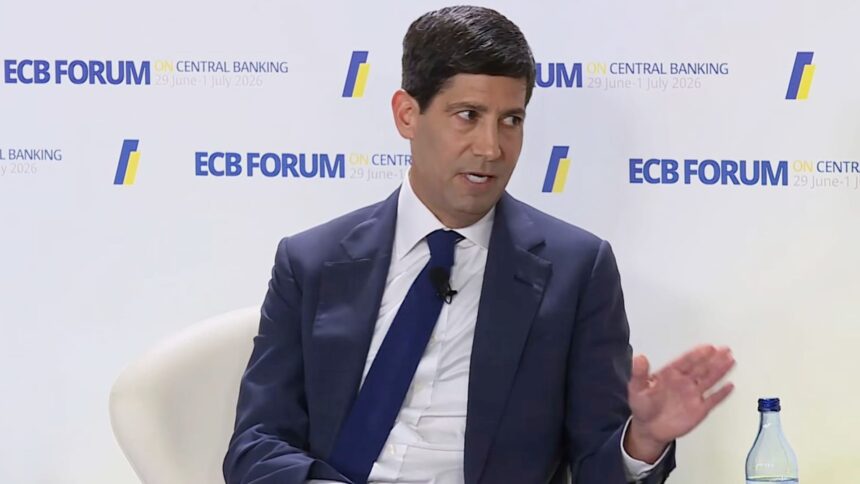
Federal Reserve Chairman Kevin Warsh has articulated a bold vision for the central bank’s future, emphasizing a transformative approach to data utilization in policy decisions. He expressed optimism that within the next year, the Fed will employ new technologies to analyze the real economy in real-time, enabling more informed decision-making. Warsh’s critique of conventional data tools, which he described as “conventional wisdom,” highlights his commitment to innovative methodologies in economic analysis.
During his remarks, Warsh also announced the imminent unveiling of leaders for five task forces aimed at examining Fed policy. He indicated that these task force leaders will include both seasoned professionals and academics from various backgrounds, potentially offering fresh perspectives on economic challenges.
In a separate discussion, Andrew Bailey, Governor of the Bank of England, laid out the increasing risks that central bankers are monitoring to avert potential financial instability. He highlighted rising leverage in both government bonds and equity markets, as well as the significance of private credit. Bailey noted the importance of closely observing asset valuations, particularly in the context of divergent movements between bond yields and equity markets, attributing some of these shifts to advancements in artificial intelligence.
Christine Lagarde, President of the European Central Bank (ECB), shared her views on the dynamic interplay between Europe and the U.S. regarding artificial intelligence and the necessity for mutual progress. She acknowledged Europe’s lag in AI investment but underscored the interdependence between the two regions, emphasizing their shared need for frontier companies in the tech sector.
Despite external pressures, including past remarks from former President Donald Trump, Warsh was firm in asserting the Fed’s independence, indicating that the institution would remain steadfast in its mandate. He reiterated that the bank’s primary focus is on maintaining price stability, stressing that inflation levels remain a pressing concern.
On the topic of AI’s impact on monetary policy, Warsh expressed a belief in its potential to foster capital expansion, although he refrained from making specific predictions about inflation. He noted that current investments in future growth, as opposed to mere financial engineering, could significantly influence the Fed’s policy direction.
Lagarde recently detailed the ECB’s rationale for raising interest rates in response to the sustained rise in inflation, indicating that unified consensus among council members facilitated this decision.
Looking ahead, Warsh’s commitment to a “new course” for the Fed was accompanied by a lack of concrete guidance regarding imminent interest rate changes. Analysts speculate that his leadership will dictate a more pronounced rate-hiking trajectory than currently anticipated by markets, dependent largely on economic behavior.
Moreover, recent data on private sector employment showed a slight decline compared to previous months, hinting at a cooling job market as the Fed navigates its monetary policies. In a notable development, Fed officials have reduced public appearances following Warsh’s recent policy meeting, suggesting a potential new communication strategy under his chairmanship.
In conclusion, as Warsh moves forward in his role, all eyes will be on how his leadership will reshape the Fed’s approach to policy, data analysis, and its interactions with global economic dynamics.