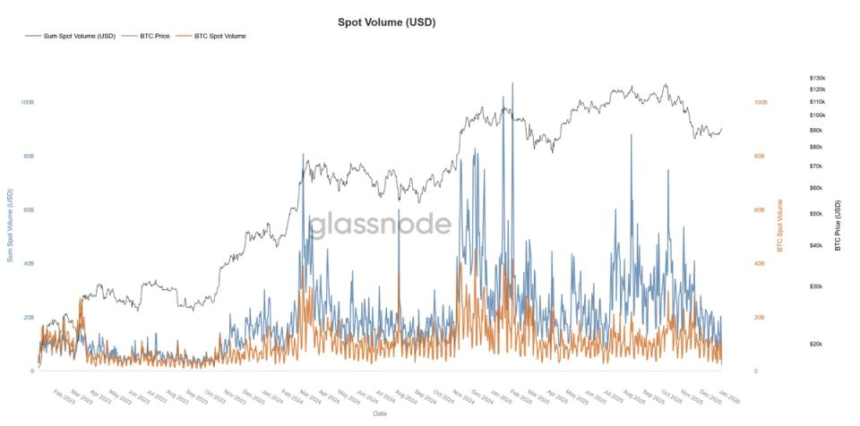
Recently, Bitcoin and the broader cryptocurrency market have exhibited signs of revival, but contrary indicators reveal weak underlying liquidity conditions, according to data from on-chain analytics firm Glassnode. This situation mirrors concerns highlighted in a previous CoinDesk analysis from November, which addressed hollow liquidity within the crypto market following the significant drop in prices around October.
Glassnode’s latest findings indicate that both Bitcoin spot trading volume and overall altcoin spot volume have plummeted to their lowest levels since November 2023. Despite the rise in prices, these low volumes suggest a troubling discrepancy, showcasing a reduction in market participation and demonstrating fragile demand beneath the recent price uptick.
Spot volume, a key metric reflecting actual trading activity on exchanges, serves as an important indicator of genuine trading interest. Normally, price gains are accompanied by increasing trading volumes, signaling the influx of fresh capital and new buyers into the market. However, in this instance, spot volumes have not only declined alongside rising prices but have also reached year-long lows, indicating a lack of widespread participation to support the upward movement.
This situation reinforces the findings of the CoinDesk research published in November, which pointed out that liquidity on centralized exchanges—specifically the market depth for Bitcoin and Ether—had not fully recovered after the October crash. This report illustrated that, following the liquidation event, the order-book depth remained consistently lower than pre-crash levels. This new, thinner base of liquidity renders the market increasingly susceptible to sharp price fluctuations.
The October liquidity event was significant, erasing $19 billion in leveraged positions within a matter of hours. Additionally, it did more than just unwind overextended bets; it fundamentally altered the market’s structure. This shift resulted in a continued decline in available liquidity, as market-making entities and liquidity providers retreated from active participation. Consequently, the market became shallower and less capable of handling large trades without inducing considerable price changes.
Currently, Bitcoin trades at approximately $93,500, reflecting a 7.5% increase since the beginning of the year. However, this price movement, achieved on minimal volume, presents several warning signs to traders. The combination of rising prices with dwindling trading activity raises concerns about the sustainability of this upward trend and the market’s overall health moving forward.