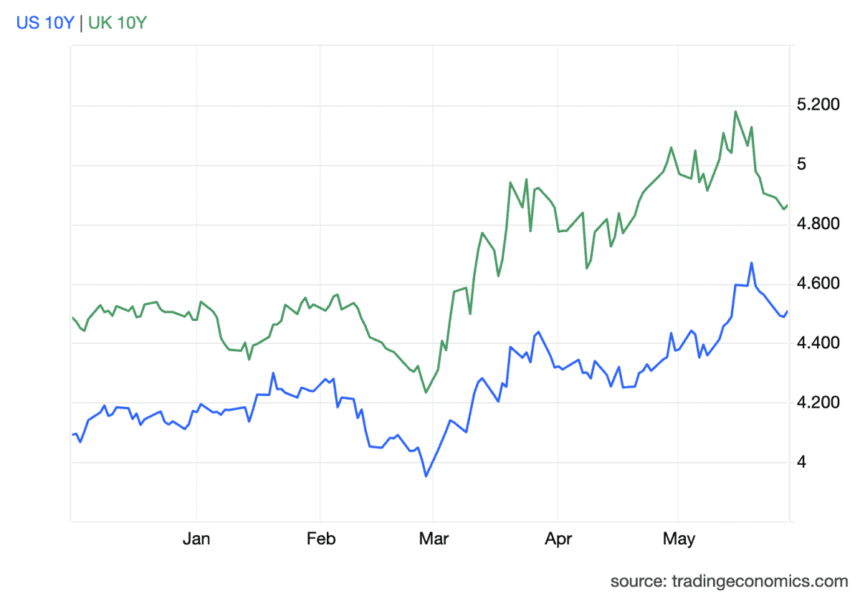
Billionaire investor Warren Buffett has long advocated for a strategy of being greedy when others are fearful and fearful when others are greedy, a principle that seems increasingly relevant as the stock market reaches new highs, while the bond market signals caution. This divergence raises questions about whether the fixed income sector is attempting to alert equity investors to potential risks ahead.
Currently, the yield on ten-year government bonds stands at 4.51% in the United States and 4.86% in the United Kingdom. Since the beginning of March, yields in both countries have trended upwards, primarily due to concerns around inflation. This is critical, as inflation erodes the real value of fixed returns on bonds, making them less appealing. When inflation worries induce selling in the bond market, prices fall and yields rise, which has been observed recently.
The cautious stance of the bond market contrasts strikingly with the relative buoyancy of the stock market. This misalignment suggests a heightened level of risk for equity investors. Traditionally, stocks carry greater risk compared to bonds, given the potential volatility of company earnings versus the obligation of firms to settle their debts. As a result, potential investors are often advised to seek higher returns to compensate for this added risk, a metric known as the equity risk premium. Current market trends indicate that this premium is unusually narrow, suggesting that equities, as a group, are comparatively more risky relative to bonds.
Despite these dynamics, there is no universal call to abandon stocks altogether. High share prices often obscure the presence of undervalued opportunities. For investors looking to navigate these choppy waters, pinpointing stocks with compelling fundamentals can be crucial.
One example of a potentially undervalued stock is MercadoLibre (NASDAQ:MELI), known as a key player in Latin American e-commerce, sometimes dubbed the region’s Amazon. Currently, the stock is 34% below its 52-week peak. The price decline is largely attributed to contracting margins as the company focuses on business growth while making it challenging for competitors. However, this strategy mirrors Amazon’s early maneuvers, suggesting that competitive dynamics could shift positively for MercadoLibre in the long term.
The stock now trades at its lowest price-to-book (P/B) ratio in years while boasting an impressive annual revenue growth of 40%. This combination presents a potentially intriguing investment opportunity, making it a consideration for those looking to add shares in June.
However, this investment narrative isn’t without risks. Notably, Argentina has faced its share of currency stability issues, which investors must weigh carefully against the opportunity presented by MercadoLibre’s current valuations. The market’s oversight of these risks and their pricing could well reflect broader misconceptions—highlighting the essence of savvy investing.
In conclusion, while the bond market signals caution amid inflation worries, the stock market may still hold attractively priced opportunities. In uncertain times, the challenge for investors is to recognize where to engage without falling victim to the fear-driven responses that often dominate financial decision-making.