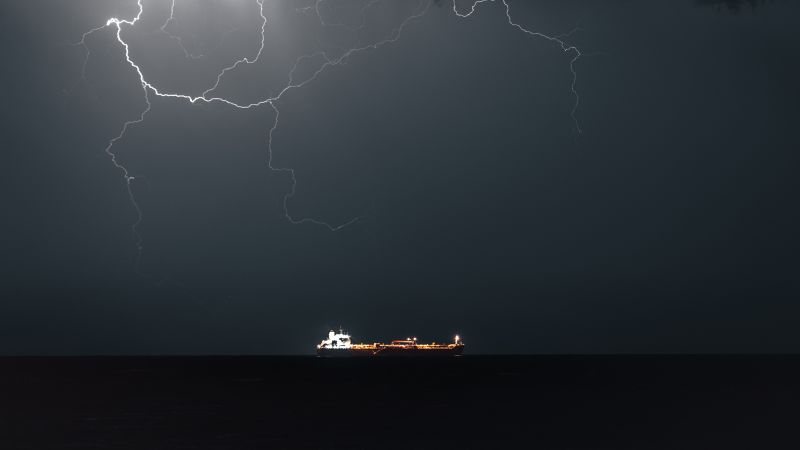
Amid escalating global economic turmoil, the critical Strait of Hormuz remains largely closed, leading to a significant spike in fuel prices and increased recession fears. This vital maritime route, through which approximately one-fifth of the world’s oil typically flows, has become a focal point of contention in international relations, particularly concerning U.S. military involvement in the region.
President Donald Trump has suggested that the U.S. could withdraw its military presence without reopening the Strait, a stance that has sparked debate among energy market experts. In a recent interview, he asserted that the waterway would “automatically open” once U.S. forces exit the conflict. “Let the countries that are using the strait take care of it,” Trump stated, encapsulating what some view as a drastic shift in U.S. foreign policy.
As gasoline prices hit $4 a gallon for the first time since 2022, Trump expressed confidence that energy costs would decrease following a U.S. withdrawal. “All I have to do is leave Iran, and we’ll be doing that very soon,” he told reporters, emphasizing his focus on domestic fuel prices. However, analysts caution that simply exiting the conflict may not resolve the underlying energy crisis exacerbated by the strait’s closure.
Dan Pickering, a prominent energy market analyst, suggested that abandoning U.S. military efforts could lead to greater long-term issues. He indicated that while an immediate drop in oil prices might occur, instability in the region could result in heightened crude costs if countries like Iran retain control. “It would be a catastrophic failure” if the U.S. allowed Iran to dominate the strait, warned Patrick De Haan from GasBuddy.
The suggestion for a military withdrawal has been met with skepticism, as many investors view it as a simplistic solution to complex geopolitical issues. Art Hogan, chief market strategist at B. Riley Financial, criticized the notion, implying it lacks coherence and reflects a misguided approach to international relations.
Though the U.S. has emerged as the world’s leading oil producer, contributing significantly to domestic fuel supplies, the effects of the Strait of Hormuz’s shutdown resonate beyond its borders. U.S. refineries depend on a mix of domestic and foreign oil, and disruptions in supply chains are expected to impact gasoline and diesel prices across the country. Economists have highlighted that states like California and New York rely heavily on imports, setting the stage for potential shortages if the situation persists elsewhere.
In the global context, the U.S. is not immune to the supply chain disruptions activated by international crises. Rising foreign demand, coupled with limited supply, could further boost energy prices domestically. Analysts predict that should the strait remain under Iran’s influence, investors would apply a “geopolitical risk premium,” contributing to sustained upward pressure on global oil prices, including at U.S. gas stations.
Despite recognizing the pressing nature of the Strait’s closure, Trump’s mixed messaging—earlier emphasizing its urgent reopening and now suggesting a U.S. exit—has left many questioning the administration’s strategic intentions. A recent post on Truth Social indicated a willingness to escalate actions if necessary, underlining the administration’s complex stance.
Bob McNally, president of Rapidan Energy Group, provided insight into the implications of a U.S. withdrawal, noting any temporary relief in oil prices wouldn’t be sustainable.
As the global economy grapples with this disruption, analysts agree that the path forward remains fraught with uncertainty. The resolution to the crisis hinges on the reopening of the Strait of Hormuz, underscoring the interconnectedness of global oil markets and their significant impact on domestic economic stability. Without a collaborative and strategic approach to address this critical chokepoint, the repercussions for consumers and the broader economy may continue to escalate.