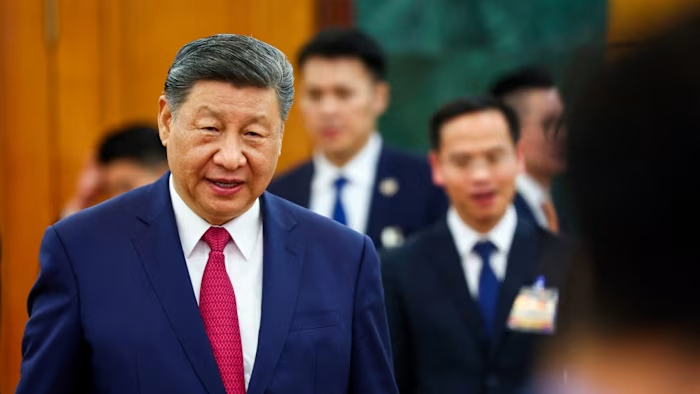
In a series of speeches delivered on Wednesday, Chinese President Xi Jinping projected confidence in the nation’s economic trajectory, asserting that China is on track to meet its 5 percent growth target for 2025. His remarks, made during a political gathering in Beijing and a televised New Year’s Eve address, emphasized achievements in economic growth, scientific innovation, and cultural influence over the past year.
Xi highlighted the rapid advancements in artificial intelligence, showcasing improvements in large AI models and self-developed chips. He remarked on the impressive capabilities of Chinese humanoid robots, including their proficiency in martial arts, and noted the spectacular aerial displays produced by fleets of drones. The domestic entertainment sector was also celebrated, with Xi mentioning the global reception of Chinese films and video games, including popular titles like “Nezha” and “Black Myth: Wukong.”
In a nod to the domestic and international landscape, Xi stated that the country’s scientific, technological, and defense capabilities have “risen to new heights.” Alongside his economic assessments, the Chinese leader commented on recent military exercises near Taiwan, which coincided with his affirmations of shared cultural ties across the Taiwan Strait, describing any trend towards reunification as “unstoppable.”
During a meeting earlier that day with members of Beijing’s political advisory body, Xi projected that China’s economic output for 2025 would amount to approximately 140 trillion RMB (around $20 trillion), stating that the economy is transitioning towards a higher quality of growth under pressure, revealing significant resilience and vitality.
Despite optimistic forecasts, the Chinese economy faces ongoing challenges, particularly stemming from a protracted crisis in the property sector, which has adversely impacted consumer spending and investment. Notably, the economy experienced its slowest growth pace in a year, posting a 4.8 percent increase in the third quarter. The government is implementing measures to invigorate consumption, a consistent weakness in China’s economy, which consists of 1.4 billion people. Recently announced initiatives include expanded fiscal support and an increase in funding for a consumer goods trade-in scheme designed to boost sales of essential electronics and appliances.
Xi also pointed to China’s contributions to global stability amidst geopolitical tensions, emphasizing the nation’s role in promoting new governance initiatives and fostering collaboration through multilateral institutions. “China has always stood on the right side of history,” he declared.
On the international front, Xi exchanged New Year’s greetings with Russian President Vladimir Putin, reaffirming commitments to deepen bilateral cooperation in the coming year. The two leaders cited progress in establishing mutual visa-free travel and enhancing cross-border energy infrastructure, illustrating the economic ties that support Russia amid ongoing conflict in Ukraine.
Looking ahead, Xi noted that the year 2026 will herald the commencement of China’s next five-year development plan, which aims to bolster growth while ensuring economic stability. Key focuses of the forthcoming plan will include enhancing domestic consumption and advancing high-tech manufacturing capabilities, addressing the need for self-reliance in science and technology, particularly amid competitive pressures from the United States. “The blueprint has been drawn,” he stated, emphasizing the imperative to move forward with these strategies.