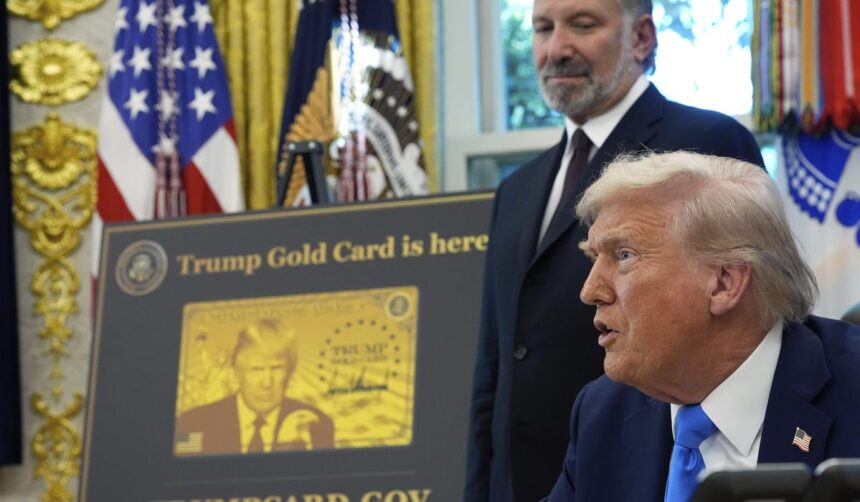
In a move aimed at shifting immigration policy, President Trump introduced his new immigration initiative, the Gold Card, which provides a high-cost pathway for wealthy immigrants to obtain U.S. residency. Announcing the program in the Oval Office, Trump stated that the initiative would not only bring in affluent individuals but would also substantially contribute to the U.S. economy.
“The Gold Card will raise billions of dollars,” Trump remarked, indicating that the funds could alleviate national debt and help reduce taxes. Individuals interested in acquiring this visa will need to pay $1 million, in addition to a processing fee. Upon successful vetting, they will be granted residency in what is described as “record time” through the program’s dedicated website, trumpcard.gov.
Commerce Secretary Howard Lutnick outlined that only 80,000 Gold Cards would be available for purchase. The program’s corporate variant, the Trump Corporate Gold Card, will cost $2 million and allows companies to sponsor employees for U.S. residency. This card also permits transferring access between employees under certain conditions. A vetting fee of $15,000 applies to both Gold and Corporate cards.
Those who successfully obtain these cards will be subject to global taxation and can pursue a pathway to citizenship. Trump emphasized the caliber of people this program is designed to attract. “We’re going to keep people in our country that are going to be very productive,” he explained, suggesting that businesses would benefit from the influx of wealthy immigrants.
Additionally, a Trump Platinum Card is in the works, set to be priced at $5 million. This card will allow holders to reside in the U.S. for up to 270 days without incurring U.S. taxes on foreign income, though it will not provide a route to citizenship.
The Gold Card initiative is intended to replace the EB-5 program, which currently provides green cards to foreigners who invest in the U.S. economy by creating jobs. Lutnick reiterated that the new program replaces current visa categorizations in favor of a system that would generate an estimated $100 billion for the U.S. Treasury.
In conjunction with the Gold Card announcement, Trump also signed an order imposing a $100,000 application fee for H-1B visas. This visa category allows U.S. companies to employ foreign workers with specialized skills and will now be more expensive and less accessible to potential applicants. The changes were framed as a means to ensure the demographic of incoming foreign workers would significantly raise the skill level and talent pool in the American workforce.
While some industry groups, such as the nonprofit invest in the USA, welcomed the push for development-friendly immigration pathways, others have raised concerns. Immigration attorney J. Mike Sevilla warned that the hefty fee for H-1B applications could deter companies from hiring necessary foreign talent, ultimately affecting several key industries reliant on skilled international workers.
The series of changes represented in the Gold Card initiative and the restructured H-1B visa process underscores a significant shift in the U.S. immigration landscape, spotlighting the complexities surrounding economic contribution and foreign talent acquisition.