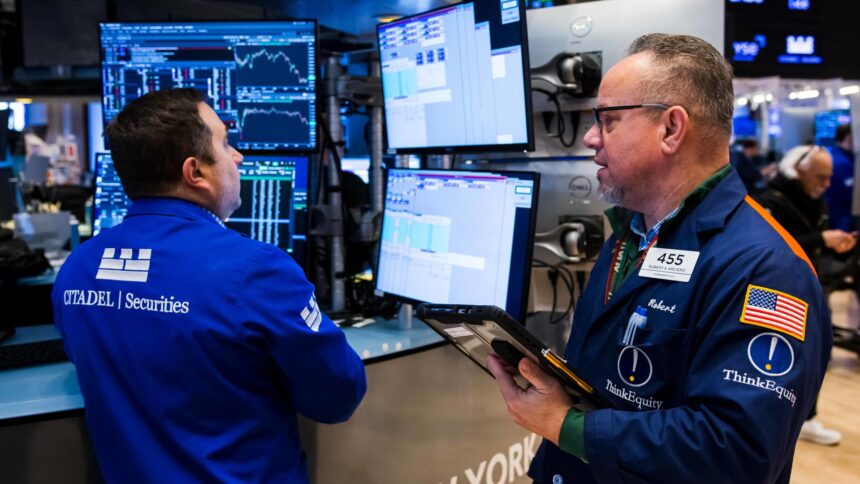
Traders at the New York Stock Exchange faced a challenging start to the week as stock futures declined on Sunday, following a week of notable gains. The latest developments in the ongoing U.S.-Iran conflict, combined with rising oil prices, played a significant role in traders’ cautious sentiment.
Futures for the Dow Jones Industrial Average fell by 253 points, a decrease of 0.5%. Similarly, the S&P 500 and Nasdaq-100 futures saw declines of 0.6% and 0.7%, respectively. This downturn came after the S&P 500 had experienced a significant increase of nearly 6% last week, marking its most robust weekly performance since late November and breaking a five-week losing streak. The Dow and Nasdaq also ended their weeks on a positive note, with the Dow advancing 3% and the Nasdaq increasing by 4.4%.
Despite the overall positive performance last week, the markets demonstrated volatility as traders continued to monitor the evolving U.S.-Iran situation. President Donald Trump issued a stark warning on Sunday regarding potential strikes on Iranian infrastructure if the vital Strait of Hormuz is not reopened by the upcoming Tuesday. In a post on Truth Social, he stated, “Tuesday will be Power Plant Day, and Bridge Day, all wrapped up in one, in Iran. There will be nothing like it!!!” This rhetoric brought renewed uncertainty to the markets.
As the week commenced, crude oil prices rose as well. West Texas Intermediate futures climbed by 1.9%, reaching $113.53 per barrel, while Brent crude saw a 1.3% increase to $110.44 per barrel. These price increases are poised to impact consumer costs as investors brace for today’s market reaction to the March jobs report, which was delayed due to the market closure on Good Friday.
The March employment data revealed an addition of 178,000 jobs, significantly surpassing the Dow Jones consensus forecast of 59,000. Meanwhile, the unemployment rate decreased to 4.3% from the previous 4.4%, although this drop was largely attributed to a notable decline in labor force participation. Ryan Weldon, a portfolio manager at IFM Investors, commented on the mixed outlook, saying, “The March employment data showed a strong rebound from February’s weak numbers but likely won’t completely reassure markets as a deeper look suggests a labor market that is limping along.” He highlighted that layoff data had risen for the first time in three months, and job openings remained lower than anticipated. Moreover, rising oil prices could contribute to increasing input costs and potentially higher inflation, adding another layer of complexity for investors navigating these turbulent times.