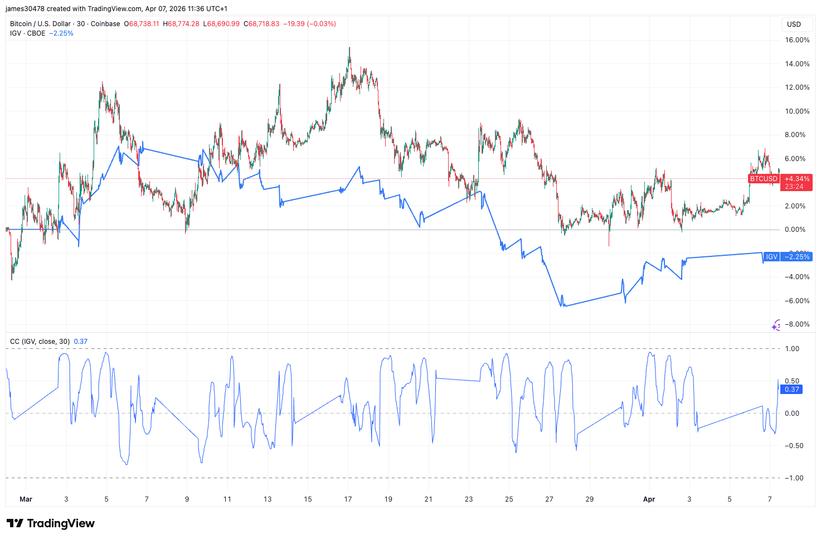
Since the outbreak of the war with Iran on February 28, the financial landscape has experienced a notable shift, particularly in the behavior of bitcoin compared to software equities. Bitcoin, which is currently priced at approximately $68,414, has emerged as one of the strongest-performing assets during this turbulent period. It has not only risen more than 5% since the conflict began but has also managed to trade above the $69,000 mark, marking a more than 0.5% increase just in the past 24 hours.
Contrarily, the iShares Expanded Tech-Software Sector ETF (IGV), which serves as a gauge for the software sector, has witnessed a decline of over 2% since the onset of the war. This stark divide indicates that investors are beginning to perceive bitcoin and software stocks as distinct assets, at least in the short term.
Historically, these two asset classes exhibited a close relationship, moving in tandem until recent developments. Over the past three months, bitcoin has suffered a drop of 26%, while IGV has recorded a 23% decline. Year-to-date figures show both assets down roughly 21%. However, looking at a five-year comparison reveals some divergence: bitcoin has appreciated by 18% whereas IGV has only seen a modest gain of 10%. This demonstrates that although both assets have been trending downward, bitcoin has done so with significantly greater volatility.
The recent conflicts have further amplified the distinctions in their price movements. Bitcoin experienced a nearly 50% downturn from its all-time high in October, while IGV has seen around a 35% decrease from its previous peak. This shift in performance is also reflected in correlation data. Prior to the war, bitcoin and IGV displayed a nearly perfect correlation nearing 1.0, signifying that they were moving almost identically. However, following the escalation of conflict, this relationship sharply weakened, with correlation dropping to 0.13—which denotes near decoupling—before stabilizing around 0.7.
A deeper investigation into why software stocks have felt a more pronounced impact during this period reveals a significant weighting within the IGV ETF toward large software and services companies like Microsoft, Oracle, and Salesforce. Investor sentiment is increasingly shifting towards concerns that rapid advancements in artificial intelligence could compress profit margins and diminish valuation multiples for software firms. This anxiety is particularly acute in the realm of Software as a Service (SaaS), where rising competition and lowering barriers to entry are perceived as threats.
In contrast, bitcoin seems to be responding to broader macroeconomic uncertainties, functioning more as a safe-haven asset amid geopolitical tensions. This divergent trajectory suggests that market dynamics are evolving and may continue to do so as the implications of the ongoing conflict unfold.