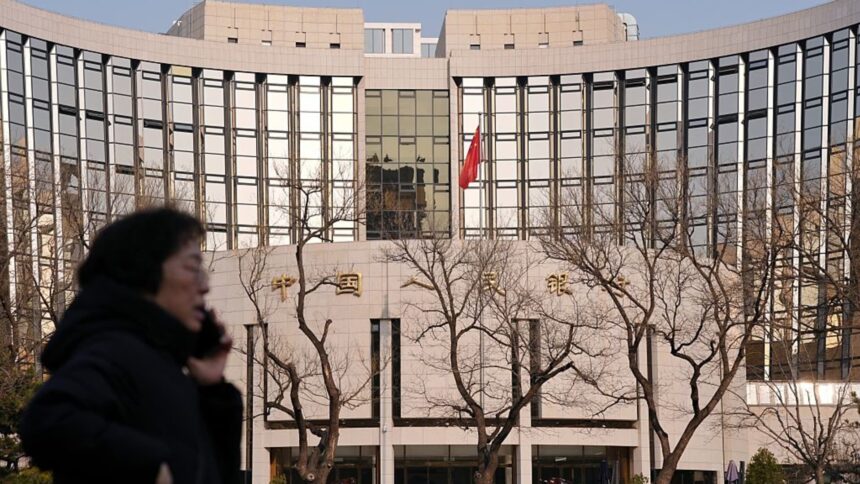
China’s central bank has decided to maintain its benchmark lending rates for the 11th consecutive month, reflecting a cautious approach as policymakers navigate the challenges posed by the ongoing conflict in the Middle East and its potential impact on local economic growth. The People’s Bank of China (PBOC) opted to keep the one-year loan prime rate (LPR) steady at 3.0% and the five-year LPR at 3.5%, which serves as a key indicator for mortgage loans.
This decision comes on the heels of a strong economic performance by China, which recorded a growth rate of 5% in the first quarter of the year, an uptick from the previous quarter’s 4.5%, thus hitting the upper limits of its annual growth target. However, the Chinese government has adjusted its growth target for 2026 to a more conservative range of 4.5% to 5%, marking the least ambitious goals set since the 1990s.
Recent economic indicators suggest an emerging trend of inflationary pressure within China. Factory-gate prices have risen by 0.5% year-on-year in March, the first increase in over three years, hinting that higher import costs are beginning to affect the domestic economy. Additionally, consumer inflation experienced its largest increase in three years, rising to 1.3% in February before slightly easing to 1% in March.
Given these signs of growth, the pressure on the PBOC for additional monetary stimulus has diminished. Economists are now recalibrating their expectations regarding potential interest rate cuts. Analysts suggest that the PBOC is likely to adopt a “wait-and-see” stance, as the rising inflation may discourage aggressive policy adjustments. Yu Song, chief China economist at UBS Securities, suggests that the government will also need time to assess the implications of the geopolitical uncertainties stemming from the Middle East.
Despite this cautious outlook, the PBOC has affirmed its commitment to a “supportive” and “moderately loose” monetary policy for the year, aimed at bolstering growth while ensuring currency stability. During a recent meeting at the International Monetary Fund in Washington, the governor of the PBOC, Pan Gongsheng, raised concerns about how rising geopolitical tensions, protectionism, and trade barriers have affected global growth and increased volatility in financial markets. He advocated for enhanced international policy coordination to maintain macroeconomic and financial stability.
Similarly, China’s finance minister, Lan Fo’an, reiterated the need to expand domestic demand and encourage consumption, alongside a commitment to provide “global public goods” that would benefit the international community. These discussions reflect China’s strategy to navigate both domestic economic challenges and the complexities of an evolving global landscape.