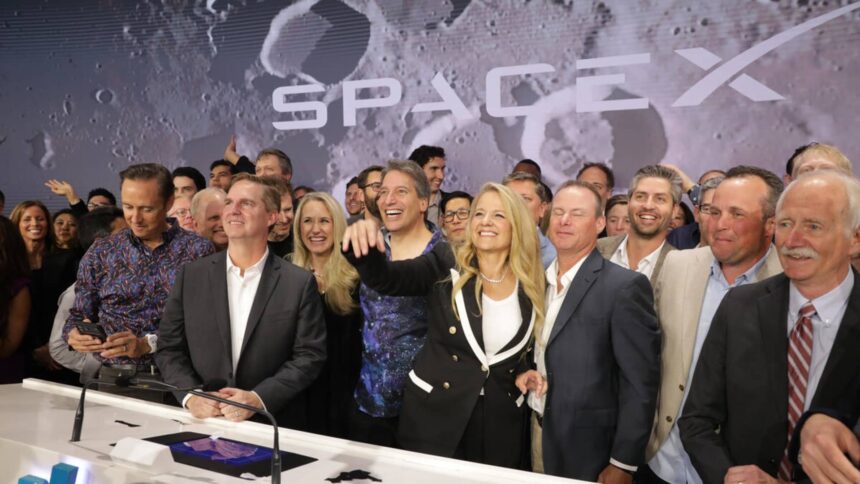
Executives at Nasdaq were abuzz as Gwynne Shotwell, President and COO of SpaceX, commemorated the company’s initial public offering (IPO) on June 12, 2026. The historic moment marked a significant milestone for SpaceX, drawing comparisons to volatile assets like bitcoin. Unlike cryptocurrency, however, SpaceX investment is increasingly unavoidable for many financial advisors and money managers, particularly those involved with index funds.
Ayman Saidi, a partner at Strategic Investment Solutions in Illinois, expressed concerns that major financial firms, including Vanguard, are betraying American savers by adhering to Nasdaq’s recent rule changes that require the integration of SpaceX into their large-cap index funds. This means that products like the Vanguard Growth Index Fund ETF (VUG) will soon include shares of SpaceX, which has a staggering market capitalization of $2.7 trillion, marking it as the fifth largest company globally following a 4.5% stock rally.
The implications of SpaceX’s inclusion in various indexes—including those managed by CRSP market indexes, Nasdaq, FTSE Russell, and MSCI—are significant. Despite its enormous market cap, SpaceX has yet to report earnings, making it a unique player in the stock market. As of the latest trading, its implied volatility reached nearly 120, considerably higher than the iShares Bitcoin ETF (IBIT), and this extreme volatility positions SpaceX as the most erratic stock within the S&P 500 and Nasdaq 100.
“The integration won’t go unnoticed,” remarked industry analysts, drawing a contrast to when Strategy was added to the Nasdaq 100 back in December 2024 during its sub-$100 billion period. This new inclusion raises questions about stability, particularly for investors uneasy with heightened volatility. “If you’re allergic to volatility, you might just want to be in bonds,” suggested Kevin Kelly, co-founder of Delphi Digital, pointing to the speculative fervor surrounding both AI and SpaceX stocks.
Despite concerns about elevated volatility, some experts believe that the situation could improve over time. Noel Smith, CIO and founder of Convex Asset Management, indicated that trading as part of an index could ultimately stabilize SpaceX’s stock. He noted that high-frequency trading (HFT) and increased liquidity may help smooth out current volatility levels.
As this situation unfolds, many investors will be closely monitoring how their portfolios react to SpaceX’s market presence and whether the volatility could indeed be transient. The integration of SpaceX into widely-held index funds symbolizes both the burgeoning complexities of modern investment strategies and the deep intrigue surrounding one of Silicon Valley’s most ambitious enterprises.