Wall Street is showing signs of modest gains in premarket trading, with oil trading below the $80 mark per barrel. This optimism comes as a tentative deal between the U.S. and Iran is expected to be signed on Friday, which could see Iran quickly reopen the Strait of Hormuz, a critical passage for global oil shipments.
Before the market opens, the futures for the S&P 500 and the Dow Jones Industrial Average remained unchanged, while Nasdaq futures saw a notable rise of 0.4%. The details of the U.S.-Iran interim deal, leaked on Tuesday, suggest that the U.S. would provide at least $300 billion to rebuild Iran post-war and seek to lift all American and United Nations sanctions, contingent on reaching a final agreement addressing Iran’s nuclear ambitions.
These proposed concessions by the U.S., which include allowing Iran to freely sell its oil, significantly surpass the terms of the 2015 nuclear deal. This previous agreement was abandoned by former U.S. President Donald Trump during his first term, who criticized it as the “worst deal ever.” Currently, Brent crude, the international oil benchmark, edged slightly higher, trading at $79.43 per barrel following a more than 5% drop the previous day. U.S. benchmark crude saw a rise of 60 cents to $76.65 per barrel.
However, economists at HSBC cautioned that the normalization of oil flows will take time, noting potential hurdles such as mine clearance, insurance matters, and restarting idled production fields as challenges that could prolong the process.
As the day progresses, the Federal Reserve is concluding a two-day policy meeting, which is the first under new chair Kevin Warsh. Analysts widely expect the Fed to maintain its benchmark interest rate, despite pressure from Trump to reduce it. Concerns over rising prices amid the ongoing conflict in Iran may prevent a rate cut, as descending rates could further increase inflationary pressures.
Chief U.S. economist at Morningstar, Preston Caldwell, opined that with weak wage and rent growth, inflation could sharply decline once the current energy price shock subsides. He does not foresee any rate hikes until 2026 and anticipates the Fed resuming rate cuts in 2027.
In equity markets, chip manufacturers experienced a bounce-back after recent losses. Micron Technology shares increased by 3.5%, recovering from a drop of over 6% the previous day, while Intel rose by 3.1% after an 8.5% decline. La-Z-Boy, known for its comfortable furniture, soared over 16% as it exceeded Wall Street’s profit expectations.
Across Europe, Britain’s FTSE 100 index remained flat following results showing that U.K. inflation held steady at 2.8% in May despite rising fuel prices. Similarly, Germany’s DAX was unchanged, while France’s CAC 40 saw a minor increase of 0.2%.
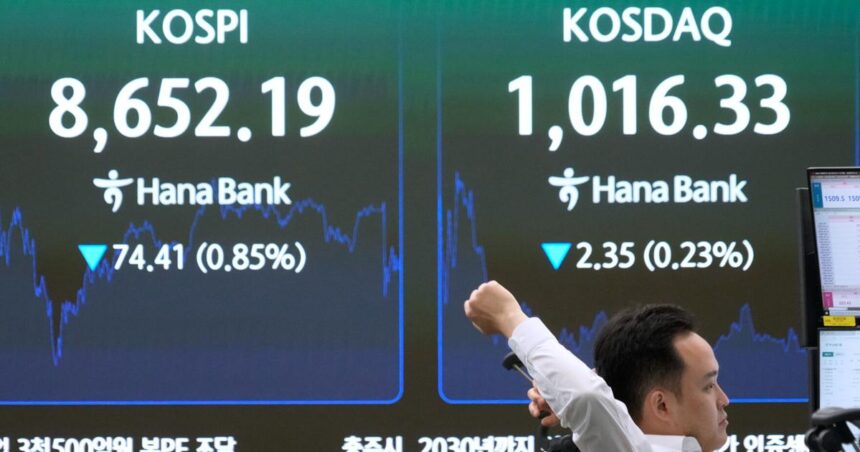
In Asia, markets generally performed well, with Japan and South Korea reaching new heights. The Nikkei 225 climbed by 0.7% to 69,902.25, bolstered by a 17% boost in Japan’s exports year-over-year, primarily driven by robust demand for technology products. South Korea’s Kospi advanced by 1.6% to close at an all-time high of 8,864.24, with leading tech stocks showing gains. However, Hong Kong’s Hang Seng index declined by 0.7%, while the Shanghai Composite inched up by 0.4%.
Australia’s S&P/ASX 200 climbed 0.5%, Taiwan’s Taiex added 0.2%, and India’s Sensex rose by 0.3%, reflecting a generally positive sentiment in the Asian markets.