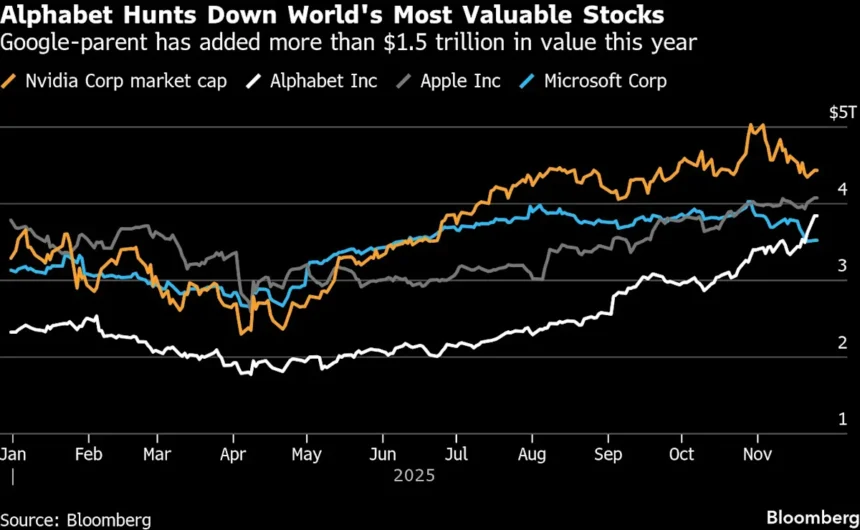
Alphabet Inc. is witnessing significant momentum in the stock market, rising sharply as the tech giant advances its efforts to compete with Nvidia Corp.’s leading artificial intelligence (AI) accelerator. This surge is catching the attention of investors who are re-evaluating the tech sector and anticipating shifts in market leadership.
Since mid-October, Alphabet shares have increased by 35%, which translates to nearly $1 trillion added to the company’s value during this period. As of the latest market close, Alphabet’s market capitalization stands approximately $590 billion behind Nvidia’s impressive $4.4 trillion, showcasing the intense competition brewing in the AI space.
Additionally, discussions are reportedly underway between Meta Platforms Inc. and Alphabet about the potential use of Google’s tensor processing units (TPUs) in Meta’s data centers starting in 2027. This would not only mark a significant endorsement for Google’s hardware but also position TPUs as a credible alternative to Nvidia’s chips, which have been considered the industry standard by major tech companies and startups alike, including Meta and OpenAI.
Investment director Alexandra Morris discussed the changing landscape, noting, “Nvidia is expected to have phenomenal growth, and now it will be very natural to see a market that is much more wary of competition.” She emphasized that the perception of Nvidia as the exclusive supplier for AI infrastructure is evolving, a shift likely influenced by elevated interest in Alphabet’s offerings.
In premarket trading, Alphabet shares continued their upward trajectory, increasing as much as 3.5%. In contrast, Nvidia’s shares saw a decline of 3.5%, with rival Advanced Micro Devices Inc. experiencing a similar drop of 3%. Such fluctuations highlight the increasing volatility and competition within the tech sector.
Nvidia’s current valuation stands at 26 times its projected earnings, which is significantly lower than its decade-long average of 35 times. Meanwhile, Alphabet’s valuation has increased, now trading at 27 times forward earnings compared to a historical average of 20 times.
While the potential agreement with Meta draws significant attention and may represent long-term challenges for Nvidia’s dominant position, experts caution that Alphabet’s TPUs must prove their efficiency and computational capability to truly compete in the market. Florian Ielpo, head of macro at Lombard Odier Investment Managers, pointed out that “Google’s TPUs represent a potential alternative, but it’s important to remember that the AI industry is still in its early stages.” He noted that while Nvidia remains the current leader, as competitors like Google enter the field, the market dynamics are likely to shift towards increased fragmentation.