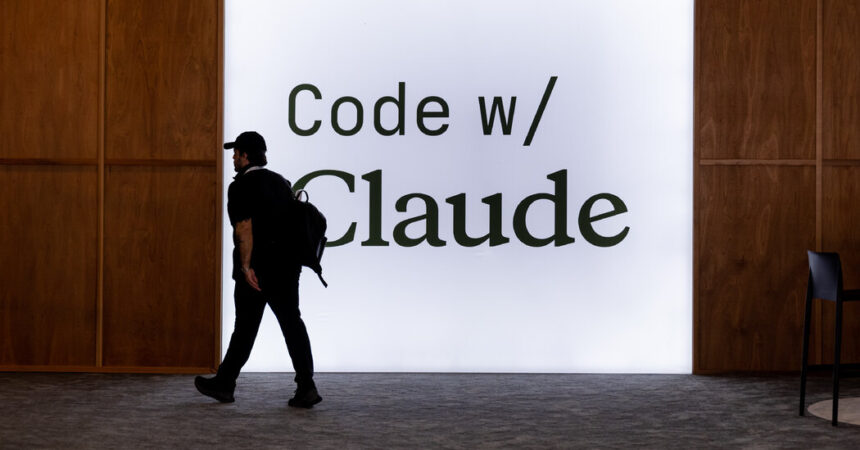
Anthropic, once a lesser-known player in the artificial intelligence landscape dominated by OpenAI, has rapidly risen to prominence in recent months, establishing itself as a formidable competitor. Recently, the San Francisco-based firm has not only engaged in high-stakes discussions with the Pentagon regarding the ethical use of AI in warfare but also rolled out a powerful new AI model, Mythos. This model claims to have an extraordinary ability to uncover and exploit hidden vulnerabilities in software systems. Furthermore, in a notable intersection of technology and ethics, Anthropic provided guidance to Pope Leo XIV for his encyclical, which issued a call for safeguarding humanity against the disruptive effects of AI.
In a significant achievement, Anthropic has officially surpassed OpenAI to become the world’s highest-valued AI startup. The company announced it secured $65 billion in financing, elevating its valuation to approximately $900 billion, exceeding OpenAI’s last standing at $730 billion. Alongside this news, Anthropic introduced its latest flagship AI model, Claude Opus 4.8, which notably enhances its capabilities in generating computer code.
This recent investment round, led by prominent investors such as Greenoaks Capital, Sequoia Capital, Altimeter Capital, and Dragoneer Investment Group, brings Anthropic’s valuation to nearly two and a half times its previous mark of $380 billion just three months prior. The financial backing underscores the demand for Anthropic’s cutting-edge AI technology, particularly its enhanced coding capabilities. Since improving its AI technology last November, the company has secured hundreds of business contracts, resulting in an impressive revenue run rate of $47 billion.
Krishna Rao, Anthropic’s chief financial officer, emphasized the significance of this funding, stating that it would enable the company to meet the surging demand for its services while remaining at the forefront of AI research.
Anthropic’s rapid ascent contrasts starkly with OpenAI’s long-established position in the industry. Only 62 days ago, OpenAI had announced raising $122 billion, a figure that took nearly a decade to achieve. In this context, Anthropic, founded in 2021, managed to eclipse that milestone in a fraction of the time.
The company’s momentum has been palpable, notably as CEO Dario Amodei advocates for AI regulation amid rising concerns over the technology’s implications. This advocacy has triggered disputes with the Pentagon centered on ethical considerations related to AI’s role in warfare.
As Anthropic continues to gain prominence, the competition with OpenAI and Elon Musk’s SpaceX intensifies, particularly as these private firms gear up for potential public offerings. SpaceX has recently disclosed its public offering prospectus, potentially hitting the stock market by next month, while OpenAI is expected to confidentially file for an IPO in the near future. Reports suggest Anthropic may also pursue an IPO this year, though the company has yet to publicly comment on this prospect.
Under pressure from Anthropic’s success, OpenAI has reportedly streamlined its focus away from secondary projects and is prioritizing its own AI coding software. Concurrently, SpaceX has entered an agreement to acquire Cursor, a widely-used software coding interface, and has committed to selling computing power to Anthropic.
In its latest funding round, Anthropic also attracted new strategic partners, including tech titans Samsung, Micron, and SK Hynix, which manufacture essential components for AI development. Anthropic noted that these collaborations will enhance its computational capabilities amidst rising demand for its new software solution.
According to PitchBook’s tracking of start-up financing, Anthropic has raised over $130 billion since its inception, boasting a diverse roster of investors that includes Capital Group, Menlo Ventures, Iconiq Capital, Lightspeed Venture Partners, as well as major tech firms like Amazon and Google.
The newly launched Claude Opus 4.8 sets itself apart in several areas, most notably in “vibecoding,” where AI models translate conversational English prompts into functional software. The new model reportedly outperforms its predecessor by 10 percent on the vibecoding benchmark test conducted by Vals AI, a firm that evaluates emerging AI performance. Additionally, Claude Opus 4.8 has demonstrated superior capabilities in mathematical problem-solving, showcasing the rapid advancements within the AI sector.
As the AI landscape continues to evolve, competition remains fierce, particularly with ongoing high-profile legal disputes, including a lawsuit by The New York Times against OpenAI and Microsoft for alleged copyright infringement related to news content used in AI models. Both companies have denied these allegations.