Asia-Pacific markets exhibited a mixed performance amid growing concerns regarding the stability of the U.S.-Iran ceasefire, following remarks from President Donald Trump. On Monday, Trump cast doubt on the truce’s longevity, implying that it was on “massive life support” after Tehran’s response to a U.S. proposal was deemed unacceptable. His statement underscored the precarious state of the ceasefire, likening it to a patient with a mere 1% chance of survival.
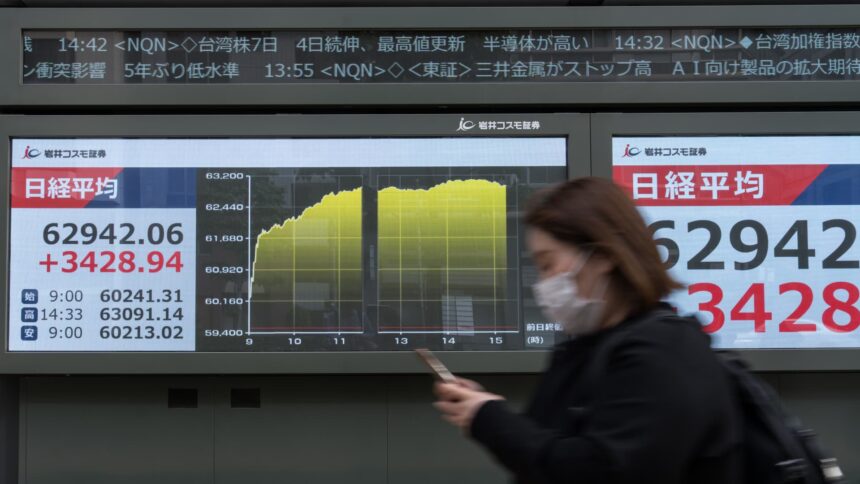
In Japan, the Nikkei 225 index saw gains of 0.52%, while the Topix index rose by 0.89%. In contrast, South Korea’s Kospi index experienced a decline of 1.95%, retreating from a record high achieved on Monday. The Kosdaq, heavily weighted towards smaller companies, fell over 1.99%, and Australia’s S&P/ASX 200 dipped by 0.24%.
The bond market in Japan also reacted to economic sentiments, with the yield on 10-year government bonds climbing to 2.545%, marking the highest level since 1997. This rise followed the release of minutes from the Bank of Japan’s latest meeting, which indicated discussions among board members regarding the necessity of an interest rate hike in the near future.
In regional performance, Hong Kong’s Hang Seng index rose by 0.30%, while the Chinese CSI 300 index fell 0.31%. In India, the Nifty 50 index dropped by 0.77%.
Despite geopolitical uncertainties, rising oil prices, and persistent inflation concerns, global equities have continued to demonstrate resilience. Jordan Rizzuto, Chief Investment Officer at GammaRoad Capital Partners, characterized the current market as a “show me” environment, where investors are increasingly cautious about responding to risks unless they have a significant impact on economic or corporate fundamentals. This behavior has shifted in recent years, as investors, having endured the pandemic, surging inflation, aggressive rate hikes, and tariff disputes, now tend to buy into market weaknesses rather than retreat.
Rizzuto pointed out that several structural factors are also propelling the ongoing rally, including retail investments in leveraged exchange-traded funds and call options. This trend has prompted financial dealers to purchase underlying equities as a hedge, further fueling the growth of buffer funds and hedged equity strategies that provide additional protection against downside risks.
In the U.S., S&P 500 futures were slightly elevated, with the Nasdaq 100 futures increasing by 0.1%. Futures associated with the Dow Jones Industrial Average showed a modest gain of 24 points, less than 0.1%.
Overnight, the S&P 500 index in the U.S. experienced a modest rise, supported by major technology stocks, even as oil prices increased following Trump’s dismissal of Iran’s latest proposal aimed at resolving the conflict. The S&P 500 closed at 7,412.84, marking a 0.19% gain, while the Nasdaq Composite ended at 26,274.13 with a similar increase of 0.1%. Both indices achieved all-time intraday highs during the session, closing at record levels, while the Dow Jones Industrial Average rose by 95.31 points, or 0.19%, to settle at 49,704.47.