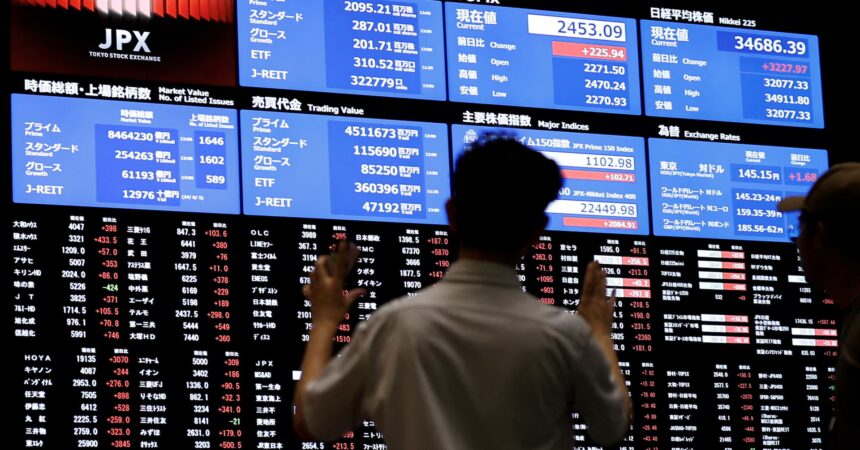
Asia shares showed signs of recovery on Wednesday, following a rebound on Wall Street that eased initial concerns stemming from a global bond market selloff and turbulence in cryptocurrency markets. Bitcoin managed to regain the $90,000 mark, while futures for the Nasdaq and S&P 500 both saw a modest rise of 0.1%.
The MSCI’s broadest index of Asia-Pacific shares outside Japan gained 0.3%, and Japan’s Nikkei advanced by 0.8%. This stabilization in the market is a welcome change after the tumultuous start to the week, which had been marked by rising expectations for a rate hike in Japan that contributed to a worldwide selloff in bonds and heightened volatility in cryptocurrencies and stocks.
Kerry Craig, a global market strategist at J.P. Morgan Asset Management, noted that the narrowing spreads and fluctuations in the Japanese yen had reignited concerns over carry trades, leading to the unwinding of leverage positions. He remarked on the sensitivity of the market to broader liquidity conditions, indicating that risk sentiment was previously tied to cryptocurrency performance.
Investor behavior during the early Asian trading session reflected muted movements in Japanese government bonds (JGBs), even as pressures remained on yields amid increasing speculation of a Bank of Japan rate hike later this month. The five-year JGB yield reached its highest level since June 2008 at 1.38%, and the 40-year JGB yield also experienced a slight increase.
The current lack of significant market catalysts shifted focus back to expectations of a Federal Reserve rate cut in the upcoming meeting, which analysts believe is bolstering market optimism. According to Tony Sycamore, a markets analyst at IG, equities could see solid support leading into the rate cut, suggesting a potential rally in mid-December, which historically has been a strong month for stocks.
Amid this backdrop, investors have also factored in a more dovish outlook for the Federal Reserve, fueled by speculation surrounding White House economic adviser Kevin Hassett as a likely candidate for the next Fed chair. His anticipated appointment, closely aligned with President Trump’s economic perspective, may influence further rate cuts, thereby affecting market dynamics. The dollar remained under pressure as a result, with the euro climbing 0.06% to $1.1632, and the British pound also rising by the same margin to $1.32235. Conversely, the dollar dipped against the yen, reflecting a 0.07% decline to 155.77.
The Australian dollar saw a downturn after data highlighted that the Australian economy had grown at a slower pace than anticipated in the September quarter. Currently, it stood flat at $0.6566.
In the commodities sector, oil prices were experiencing a slight recovery after initial losses, though the markets continued to grapple with concerns over both faltering peace negotiations between Russia and Ukraine and fears of an oversupply. Brent crude futures edged up by 0.06% to $62.49 a barrel, while U.S. crude rose 0.07% to $58.69 per barrel. Meanwhile, spot gold prices saw a marginal increase of 0.2%, reaching $4,216.13 an ounce.
These developments underline a complex interplay of factors influencing market sentiment, as investors navigate a landscape shaped by monetary policy uncertainty and evolving economic indicators.