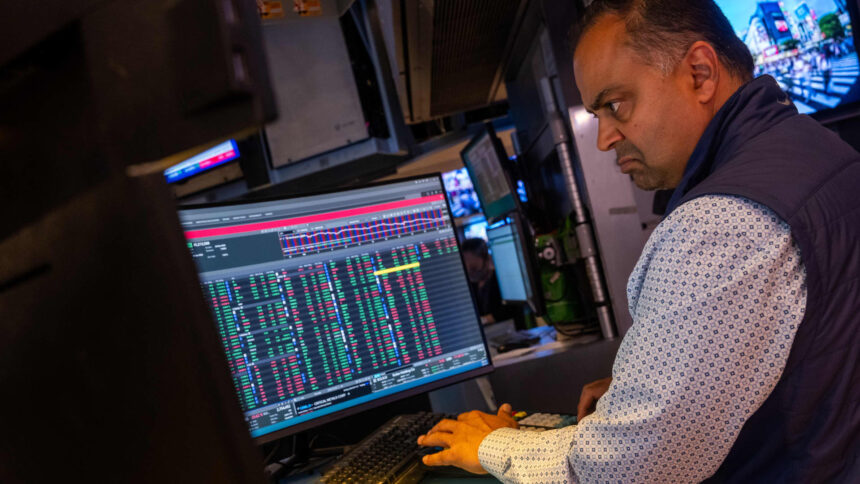
Traders on the floor of the New York Stock Exchange have experienced notable fluctuations in the stock market since the onset of the Iran war more than two months ago. While the market’s volatility has led to sharp sell-offs, financial experts view these swings as an opportunity rather than just a challenge.
Kevin Khang, a senior global economist at Vanguard Group, emphasized that drawdowns can serve as valuable stress tests for investors. He noted that the discomfort caused by market fluctuations reveals important insights into individual risk tolerances that a stable market might not indicate. Khang explained how this emotional response during market downturns can help investors modify their asset allocations to align more closely with their comfort levels.
The S&P 500 index saw a decline of approximately 9% from its peak closing price on January 27 to its low on March 30, coinciding with the early days of the conflict. Since then, the index has rebounded to reach new all-time highs, despite the ongoing situation in the Middle East. As of Thursday afternoon, the market experienced a setback as traders awaited Iran’s reaction to a U.S. proposal aimed at bringing the conflict to a close and ensuring the safe passage of oil tankers through the strategic Strait of Hormuz.
Amid this context, the CBOE volatility index (VIX) spiked to its highest levels since April 2025, reflecting heightened market anxieties reminiscent of prior tumultuous periods, such as when steep tariffs were introduced during the Trump administration. Financial advisors consider this volatility a natural component of the stock market, suggesting that investors who endure these fluctuations often benefit from higher long-term returns than those who favor more conservative investments like bonds or cash equivalents.
Khang noted that the Iran war-related downturn appears less severe when compared to prior market history, observing that many younger investors, who have largely experienced a bull market, might find these recent shifts more disorienting. He pointed out that many individuals under 50 have not encountered significant market pullbacks like those witnessed by older generations, which can lead to an unrealistic sense of security.
Ryan Greiser, a certified financial planner, echoed Khang’s sentiments, highlighting the importance of understanding one’s risk tolerance and capacity. He provided an analogy from boxing, stating that while individuals may formulate meticulous investment strategies, unforeseen challenges—akin to getting “hit in the mouth”—require adaptability.
Investors must differentiate between risk capacity, their financial ability to take risks, and risk tolerance, their personal comfort with market volatility. For instance, a young person with a long investment horizon may afford to be entirely equity-based, whereas an older individual with significant resources might have the capacity to take risks yet still feel uncomfortable with the potential for short-term losses. This mismatch can lead to poor investment decisions based on emotional reactions during downturns.
The ongoing situation in Iran may serve as a turning point for many investors to reassess their emotional resilience regarding financial setbacks, helping them calibrate their stock-bond allocations accordingly. Financial planners, including Carolyn McClanahan, advise a balanced approach that preserves essential growth components in a portfolio, even for those nearing or in retirement. For example, common target-date funds still incorporate substantial stock holdings despite an investor’s inclination toward bonds for stability.
In summary, while market volatility can be daunting, it presents a critical opportunity for individuals to reflect on their risk profiles, align their portfolios with their comfort levels, and ultimately make informed investment decisions tailored to their financial circumstances.