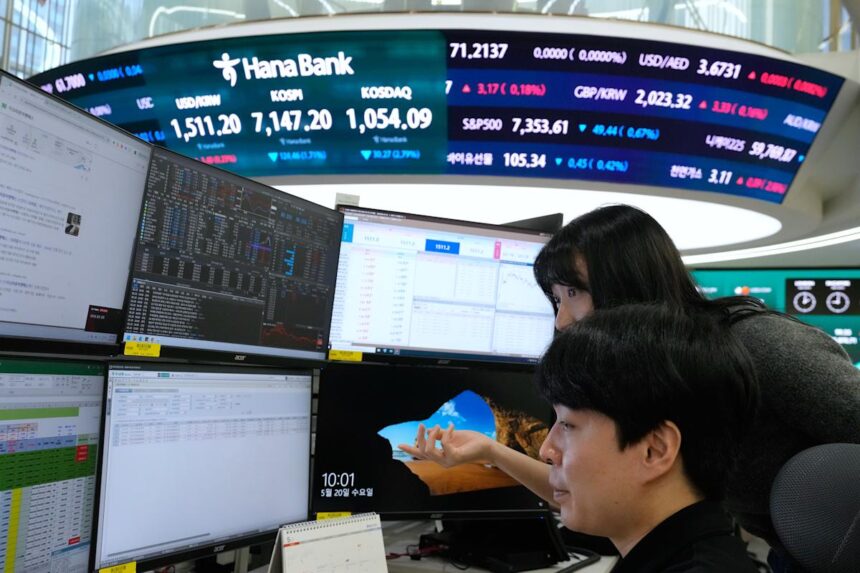
Asian shares saw a positive uptick on Friday, buoyed by modest gains on Wall Street from the previous day. Investors reacted favorably despite ongoing concerns surrounding oil prices, which rose as diplomatic efforts to resolve the Iran war yielded limited progress.
The fluctuations in oil prices were notable, having eased on Thursday during U.S. trading. This slight reprieve alleviated some pressure in the bond market, resulting in a decrease in yields. Earlier this week, bond yields had spiked, raising concerns that high rates could stifle economic growth globally and adversely impact various asset prices, including stocks and cryptocurrencies.
In the latest market movements, U.S. futures pointed towards an optimistic open, with Tokyo’s Nikkei 225 experiencing a significant jump of 2.7%, closing at 63,352.44. A report indicating that inflation had dipped to a four-year low of 1.4% in April, despite rising oil and gas prices due to the ongoing conflict, contributed to this positive sentiment.
South Korean markets reflected a similar optimism, with the Kospi gaining 0.6% to reach 7,860.59. Hong Kong’s Hang Seng index rose by 1.2%, closing at 25,685.65, while the Shanghai Composite index inched up by 0.5%, finishing at 4,096.24. Australia’s S&P/ASX 200 saw a 0.5% rise to close at 8,664.00, and Taiwan’s Taiex traded 1.5% higher. India’s Sensex also saw a slight uptick of 0.2%.
Despite the works in progress, oil prices remained high due to ongoing disruptions around the Strait of Hormuz, a crucial waterway for oil and gas shipping, where activity has yet to return to pre-conflict levels since the Iran war began in late February. Efforts by the U.S. and Iran to negotiate an end to the war have thus far dragged on, contributing to the prevailing uncertainty in the markets. Within Congress, Republicans faced challenges in gathering necessary support to pass legislation that would compel President Donald Trump to withdraw from the war, pushing any decisions on the matter to June.
As for oil prices, Brent crude, regarded as the international benchmark, increased by 1.5% to reach $104.08 a barrel—significantly up from around $70 prior to the war’s outbreak. In the U.S., benchmark crude prices rose 0.9% to $97.25 a barrel.
Market analysts remain cautiously optimistic, stating, “Markets are still searching for signs of progress in a potential deal between the US and Iran,” according to ING commodities strategists Warren Patterson and Ewa Manthey. They noted the ongoing uncertainty surrounding these negotiations.
On Wall Street, Thursday witnessed positive movement as the S&P 500 gained 0.2%, closing at 7,445.72. The Dow Jones Industrial Average saw a boost of 0.6%, ending at 50,285.66, while the technology-driven Nasdaq composite slightly advanced by 0.1%, coming in at 26,293.10. Notably, shares of Nvidia fell by 1.8%, despite reporting better-than-anticipated quarterly results amid the ongoing artificial intelligence boom, with some analysts suggesting that its shares remained undervalued.
In contrast, airline stocks experienced gains, with Southwest Airlines rising by 2.7% and American Airlines climbing 4.9%, as oil prices initially eased before rebounding. Fashion brand Ralph Lauren saw a significant surge of 13.9% following strong quarterly earnings.
In terms of bond market developments, the yield on the U.S. 10-year Treasury was reported at 4.56%, down from more than 4.67% earlier in the week, highlighting a response to the easing global inflationary pressures linked to the ongoing conflict.