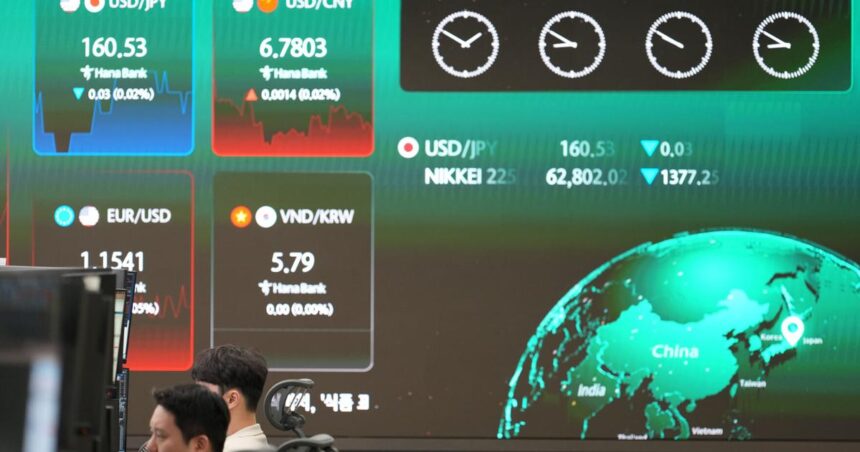
Asian stock markets exhibited a mixed performance on Thursday, following a significant sell-off in artificial intelligence (AI) stocks that severely impacted the U.S. market. U.S. futures, however, showed signs of recovery. Oil prices experienced a decline after an initial increase, coinciding with the U.S.’s launch of a second round of airstrikes against Iran.
In Japan, the Nikkei 225 saw a slight uptick of less than 0.1%, closing at 64,217.27. South Korea’s Kospi recorded a 0.4% increase, reaching 7,763.95. Conversely, Hong Kong’s Hang Seng index fell by 0.9% to 24,180.03, and China’s Shanghai Composite index dipped 0.2% to 3,987.01. Australia’s S&P/ASX 200 also lost 0.2%, settling at 8,633.20. Taiwan’s Taiex decreased by 0.2%, while India’s Sensex managed to gain 0.4%.
On Wall Street, the S&P 500 saw a decline of 1.6%, marking its first consecutive loss in three weeks, with a closing value of 7,266.99, a level reminiscent of early May. The Dow Jones Industrial Average plummeted by 953 points, or 1.9%, to 49,918.78, while the Nasdaq composite led the decline with a 2% drop to 25,169.50.
Markets have been volatile since last week when AI-related stocks shifted from exponential growth to steep declines. Concerns have arisen regarding whether these stocks have experienced excessive inflation in prices due to a speculative AI frenzy. Investors are now questioning if this pullback signifies a correction of overly optimistic valuations or the onset of a more sustained downturn.
Notable declines included Super Micro Computer, which witnessed a staggering 28% drop after announcing plans to raise $7 billion through stock sales, prompting fears of dilution among current shareholders. Micron Technology exhibited volatility, swinging from early losses to near-gain before ultimately settling down 4.7%. Industry giant Nvidia, which has thrived amid the AI boom, was a notable drag on the S&P 500 after a 3.7% drop. Another prominent figure, Broadcom, also experienced a significant 5.1% decline.
Investor sentiment has been affected by the anticipation surrounding highly anticipated stock market debuts for several AI giants, including SpaceX, potentially leading to cash withdrawals from existing positions in AI.
Meanwhile, early Thursday saw Brent crude oil prices decrease by 0.3%, settling at $92.81 per barrel, down from earlier highs. U.S. benchmark crude fell by 0.4% to $89.70 per barrel. The energy market was further strained by geopolitical tensions in the Middle East, following President Trump’s assertion that Iran would face consequences due to stalled negotiations. This conflict has effectively restricted oil tanker traffic through the strategically critical Strait of Hormuz, hampering crude deliveries.
The rising oil prices have contributed to increasing inflation, evident in a recent report indicating the fastest rise in consumer prices in the U.S. in three years. Market observers predict that the Federal Reserve may need to increase interest rates in response to these pressures and robust job market conditions. Such high yields could potentially dampen economic activity and adversely affect various investment categories, including stocks and cryptocurrencies, with critiques labeling the AI sector as a bubble driven by inflated valuations.
Other market movements included a dip in the dollar, which fell to 160.52 Japanese yen from 160.56 yen, while the euro rose to $1.1547 from $1.1537.