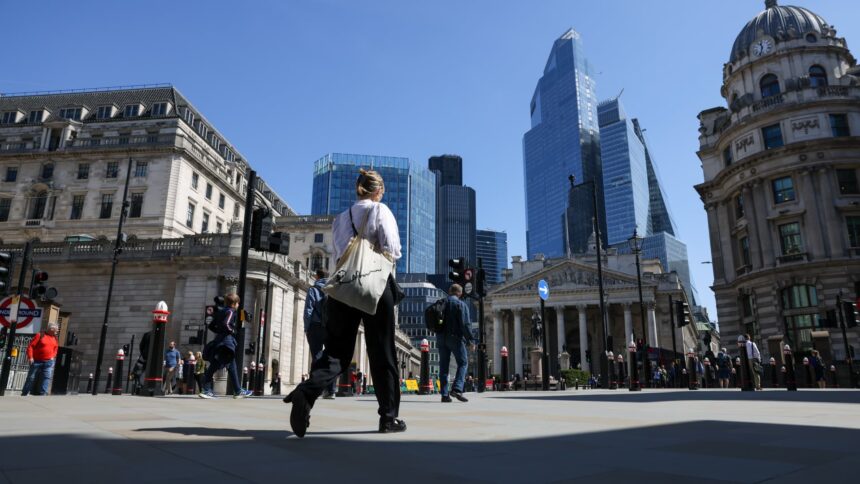
Commuters in London navigated the busy streets near the Bank of England (BOE) this week, as discussions surrounding monetary policy intensified among policymakers within the institution. Following the conclusion of the previous hiking cycle last year, there appears to be a significant divide among BOE officials regarding their next steps, particularly as pressures on interest rates loom large.
Recent geopolitical developments, particularly the outbreak of the Iran war, have added complexity to the UK’s already intricate economic landscape. These events have seen renewed inflation concerns, prompting speculation that the BOE may either hold current interest rates steady or, in a more surprising turn, increase them in the near future.
The International Monetary Fund (IMF) recently provided an updated forecast for the UK economy, upgrading its growth estimate for 2026 while also advising caution. The organization emphasized that monetary policy must remain stringent to mitigate the effects of rising energy costs on core inflation and wage growth. In a report, the IMF indicated that maintaining the current Bank Rate of 3.75% throughout the year would help anchor long-term inflation expectations and prevent secondary economic impacts.
Despite this, the IMF warned that the BOE should remain agile, with the capacity to implement interest rate cuts if the economic environment demands it. The report highlighted the uncertain landscape, advising that the central bank be prepared to adjust its policy quickly if inflationary pressures exceed forecasts.
In terms of economic performance, the IMF offered a glimmer of optimism, revising its growth forecast for this year up to 1%, from an earlier prediction of 0.8%. The organization recognized the UK economy’s resilience, noting that while recent geopolitical tensions have tempered near-term growth prospects, there is cause for cautious optimism. The IMF projected a gradual recovery as the adverse effects of the ongoing conflict lessen, although they cautioned that elevated energy prices would likely push inflation upward temporarily, delaying the central bank’s target return to 2% by approximately one year.
The IMF highlighted the importance of clear communication from the BOE regarding its decisions, urging that actions should be based on data and assessed during each policy meeting. Notably, the organization had previously indicated that the UK was set to experience one of the sharpest economic declines among developed nations due to the fallout from the Iran conflict. Despite such warnings, recent data reflecting a 0.6% growth in the first quarter suggests that the country’s economy has performed better than anticipated.
As the situation continues to unfold, both policymakers and economists will be closely monitoring developments, hopeful that the effects of rising energy prices will soon stabilize, leading to a full recovery as the economic landscape continues to evolve throughout 2027 and beyond.