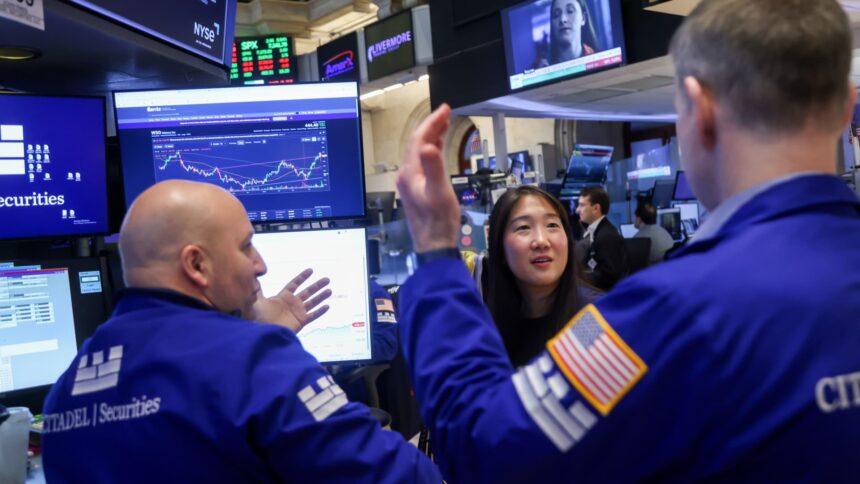
Traders on the floor of the New York Stock Exchange witnessed a volatile trading session on Wednesday, particularly influenced by the earnings reports from major technology companies. In after-hours trading, S&P 500 futures rose by 0.3%, with Nasdaq 100 futures climbing 0.5%. However, futures for the Dow Jones Industrial Average experienced a dip, falling 128 points, or 0.2%.
During the regular trading session, the Dow recorded a significant loss of 280.12 points, or 0.57%, marking its fifth consecutive day of decline. The S&P 500 saw a marginal decrease of 0.04%, while the Nasdaq Composite managed a slight gain of 0.04%, reflecting mixed investor sentiment.
Shares of Meta Platforms, often referred to as one of the “Magnificent Seven” tech giants, fell nearly 6% following disappointing earnings. The company reported capital expenditures that missed expectations, coupled with lackluster user growth, leading to investor concerns.
Contrastingly, Microsoft performed better, showing minimal change in its stock price after it reported earnings that exceeded analysts’ expectations, including a remarkable 40% surge in revenue from its Azure cloud services. Other tech titans, Alphabet and Amazon, also released their earnings later in the evening. Alphabet’s shares surged 6%, fueled by a revenue beat and strong performance from Google Cloud. Amazon’s stock jumped 4% after it reported stronger-than-expected quarterly results and robust growth in its cloud computing division.
In the oil market, prices rose amidst escalating tensions between the United States and Iran. Reports indicated that President Trump has instructed his aides to prepare for a prolonged blockade of Iran, rejecting a proposal for reopening the Strait of Hormuz until a deal addressing Iran’s nuclear program can be reached. As a result, West Texas Intermediate crude futures increased by approximately 1%.
On the monetary policy front, the Federal Reserve decided to maintain interest rates within the 3.5% to 3.75% range, a stance anticipated by investors. However, the 8-4 vote indicated a significant division within the policymaking body, marking the first time since 1992 that four Fed officials dissented. With Fed Chair Jerome Powell’s term ending next month, Kevin Warsh, nominated by Trump to succeed him, is poised to take over the central bank. Sonu Varghese, a global macro strategist at Carson Group, expressed concerns about the Fed’s potential direction, citing rising inflation fears among committee members.
Looking ahead, a series of economic indicators are expected to be released, including the preliminary reading of first-quarter gross domestic product (GDP) and the personal consumption expenditures (PCE) report, which is the Fed’s preferred inflation metric. Core PCE is anticipated to come in at 3.2% for March, as previously stated by Powell.
As April closes, more earnings reports are on the horizon from major companies including Caterpillar, Merck, Eli Lilly, and Bristol-Myers Squibb, with tech giant Apple set to release its numbers later in the afternoon. Notably, both the S&P 500 and Nasdaq are on track for substantial advances of 9.3% and 14.3%, respectively, marking their best monthly performances since 2020. The Dow, too, is expected to end April with a strong 5.4% gain, its best monthly result since November 2024.