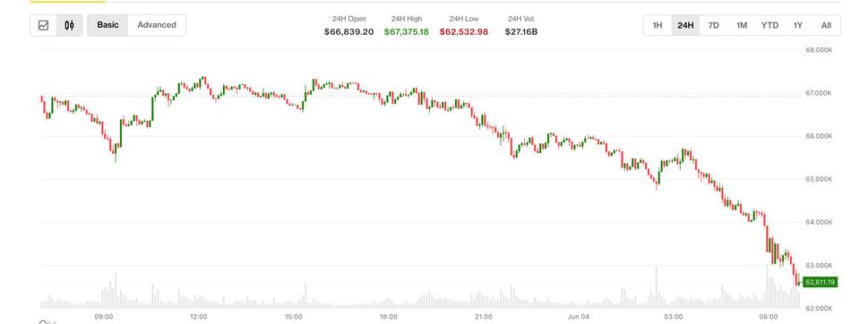
Bitcoin continued its downward trend early Thursday, dropping to $63,000—a figure not seen since February 24. This latest decline marks a more than 14% loss for the week and a significant 21% fall over the past month, as reported by CoinDesk data. The cascading selloff has heightened demand for protective options, pushing the 30-day implied volatility index (BVIV) to 53.17, the highest it has reached since April 2.
The recent turmoil in the cryptocurrency market has led investors to withdraw $50 million from U.S.-listed spot exchange-traded funds (ETFs) on Wednesday. This development adds to concerns about institutional demand, as it now marks the 13th consecutive trading day of outflows from these investment vehicles.
Industry experts are noting that a broad sell-off in cryptocurrencies was initially ignited by strategy transfers, leading to ETF outflows, and is now being exacerbated by speculative news regarding potential liquidations tied to the collapsed exchange Mt. Gox. Paul Howard, senior director at liquidity provider Wincent, commented on the situation, suggesting that discussions around Bitcoin potentially testing the $50,000 mark as a bottom have begun circulating among traders.
Howard emphasized that while there is still significant distance to cover, the lack of positive catalysts combined with liquidity moving toward sectors such as artificial intelligence points to further volatility on the horizon. As traders analyze market movements, many are closely eyeing the $60,000 mark as a potential support level, especially considering the February crash where prices nearly approached that threshold before the downturn subsided.
Analysts from the data tracking platform Material Indicators indicated that they are monitoring the low $60k range as critically significant. They noted that this area coincides with key market factors, including a local low around $59.9k and the positioning of the 200-week moving average. While they cautioned that this does not guarantee support, it does suggest a crucial decision point for the market in the near future.