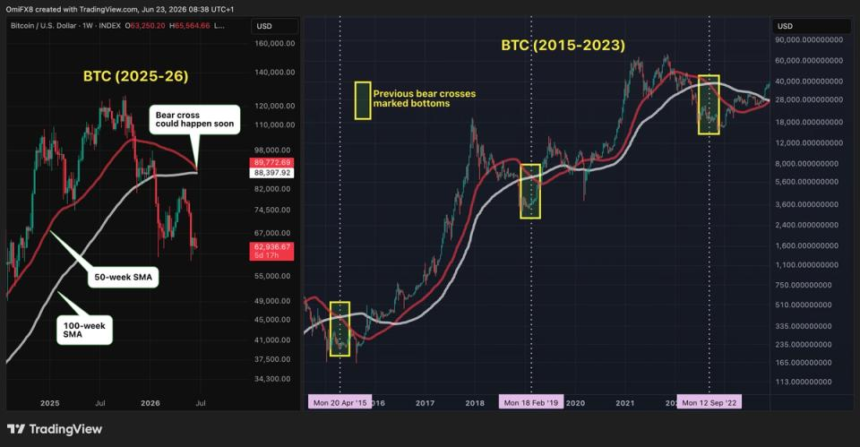
In recent discussions regarding the performance of Bitcoin, critics have highlighted that analyzing only three past instances of bear crosses may not offer a definitive conclusion on market trends. This viewpoint acknowledges the validity of concerns, given that the historical occurrences of this phenomenon appear to be consistent with the established reputation of long-duration moving averages as “lagging” indicators.
To understand this further, it’s essential to consider what these moving averages represent. Specifically, they indicate the average price of Bitcoin over the past 50 and 100 weeks, effectively mirroring price actions that have already occurred rather than projecting future behavior. The current bear cross is a reflection of Bitcoin’s significant price correction, which saw its value decline by approximately 50% from a peak of $126,000 in October to around $60,000.
This historical context illustrates that by the time bear crosses materialize, much of the market speculation has dissipated; short-term traders usually have exited the market, and a phase of capitulation often precedes these signals. Therefore, traders might interpret the upcoming intersection of these averages as a significant indicator, potentially indicating a market bottom.
However, it must be noted that reliance on past patterns does not guarantee similar outcomes in the future. The dynamic nature of the economy can drastically shift conditions, influencing trends in unpredictable ways. As such, key factors including bond yields, ETF flows, and actions from institutional players like Strategy (MSTR) are critical in assessing Bitcoin’s trajectory.
As it stands, Bitcoin is trading near $62,400, with the 50-week moving average currently at $89,771 and the 100-week average standing at $88,397. The interplay of these averages and external economic factors will be crucial in shaping the future outlook for Bitcoin investors.