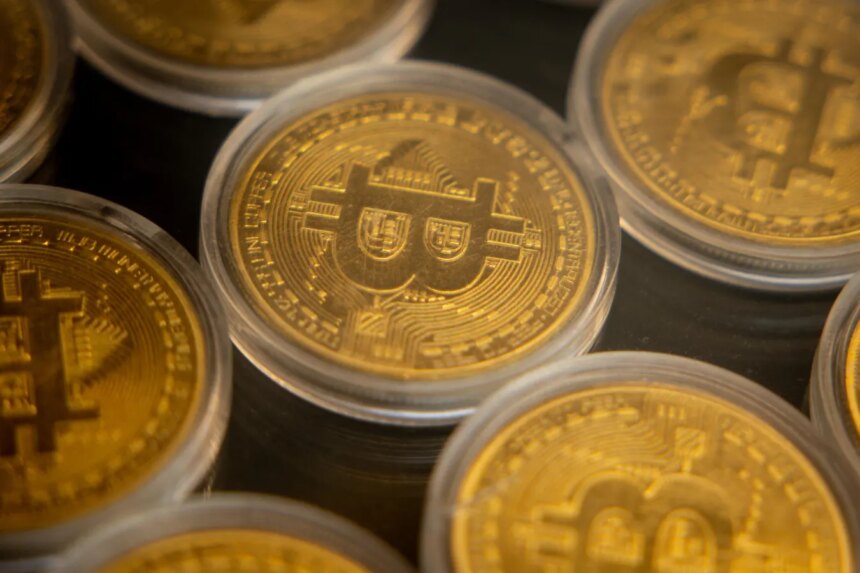
In Istanbul, a cryptocurrency exchange office showcased gold Bitcoins in its window, reflecting the frenzied current state of the cryptocurrency market. Following the recent re-election of Donald Trump, Bitcoin prices have surged to nearly $77,000, fueled in part by his commitment to bolster Bitcoin and the cryptocurrency sector. This significant increase, however, contrasts starkly with longstanding criticisms of Bitcoin’s role as a reliable currency.
Critics argue that Bitcoin fundamentally lacks utility as money. The volatility of its value raises questions about its viability for everyday transactions. The surges in Bitcoin’s price do not signify stability; rather, they highlight the very nature of its failings as a currency. True money is characterized by its constancy and quietness, serving merely as a measure of value without dramatic fluctuations.
The analogy to standard measurements such as degrees or inches underscores this point. Just as no one debates the strength of a degree or the volume of a cup, so too should currency maintain a consistent value that fosters trust in its use for trade. When currency becomes tumultuous, as Bitcoin has, it complicates exchanges of goods and services, leaving participants uncertain instead of facilitating straightforward transactions.
Bitcoin’s reliance on its dollar valuation means it fails to provide a stable medium for trade. In every instance where value fluctuates, there exist winners and losers, which runs counter to the fundamental objective of money: to create a balanced exchange of equivalent value. This disparity suggests that Bitcoin, instead of serving as money, functions more as a speculative investment where unpredictability reigns.
Furthermore, the theoretical frameworks supporting Bitcoin—rooted in neo-Austrian and neo-monetarist thought—claim that inflation arises from an overabundance of money while stable value reflects a controlled supply. However, this perspective misjudges the relationship between money and production. Money does not stimulate production; rather, it is a product of it. The flow of money correlates with the cycle of production, reflecting the value created rather than directing it.
These misconceptions are particularly evident among proponents of strict supply control. Their belief in a “perfect” monetary system, whether through central banks or the idealistic vision of Bitcoin’s creator, overlooks the real dynamics of production and value. Instead of a predetermined quantity of currency, the circulation of money should reflect the ongoing processes of production within the economy.
Bitcoin’s fixed supply presents an inherent flaw in these monetary theories, serving as a case study in their inadequacies. As Bitcoin’s price volatility illustrates, the conflict between these economic schools reveals a misunderstanding of what constitutes effective money. In essence, rather than being an evolution in currency, Bitcoin exemplifies the complexities and challenges that arise when monetary systems deviate from their foundational principles.