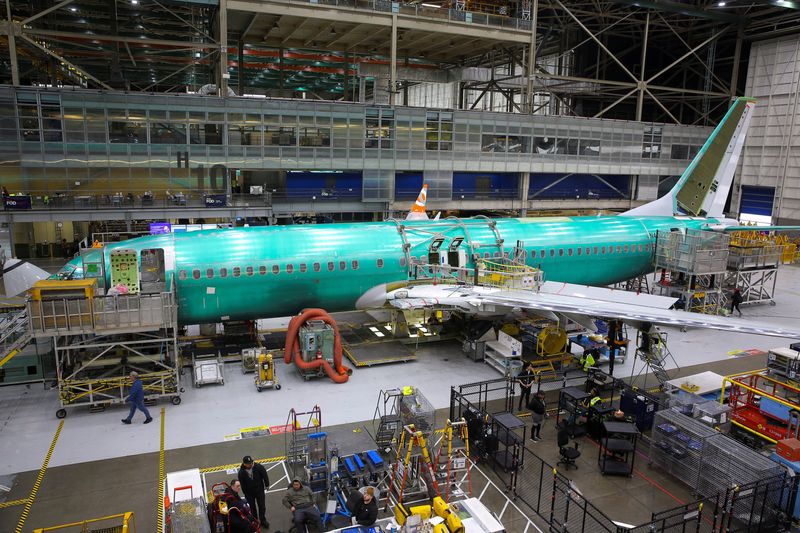
Boeing has announced a significant increase in production of its 737 jets, raising output to 47 units per month from the previous 42, following consultations with the Federal Aviation Administration (FAA). CEO Kelly Ortberg confirmed the change during the Bernstein Annual Strategic Decisions Conference, stating that the company is on track to reach this production rate within a couple of months. He outlined plans for further expansion to 52 jets per month early next year, which will be facilitated by the opening of a fourth 737 production line in Everett, Washington.
This production ramp-up is crucial for Boeing, particularly in light of the challenges the company has faced in recent years, including over $35 billion in losses from 2019 to 2024. In a positive turn, Boeing reported a profit of $2.2 billion last year, largely credited to the $10.6 billion sale of its subsidiary, Jeppesen, a digital aviation services provider. Following the announcement, Boeing’s shares increased approximately 4% in morning trading before stabilizing at their opening price.
Ortberg also shared updates on the certification status of the 737 MAX models. Certification flight tests for the MAX 7 and MAX 10 have largely been completed, although the process for these models, as well as the new widebody 777-9, has taken significantly longer than anticipated, impacting the company’s earnings. Ortberg expressed confidence that remaining flight testing phases for the new 737 MAX engine anti-ice system will proceed smoothly.
In addition to the 737, production of Boeing’s twin-aisle 787 has returned to eight jets per month after experiencing disruptions earlier this year due to engine shortages from GE Aerospace. The delivery of completed 787s has also faced delays due to certification issues with new premium seating. Nonetheless, Boeing aims to increase 787 production to 10 jets per month later this year, contingent on the consistency of engine deliveries.
Interestingly, amid geopolitical tensions and rising fuel costs, Boeing has not received requests from customers to delay jetliner deliveries. Instead, many clients have expressed willingness to accept earlier deliveries. This is a reassuring sign for the manufacturer as it strives to maintain momentum.
China recently made a notable commitment to order 200 Boeing jets, marking the first significant order from the country in nearly a decade during discussions between President Donald Trump and Chinese leader Xi Jinping. Despite initial investor hopes for a larger deal, Ortberg emphasized that the quantity should not overshadow the long-term growth potential, as China requires hundreds of new aircraft annually to support its economic expansion.
On the military front, demand for Boeing’s munitions is reportedly “through the roof.” Ortberg noted that the company is currently focused on how many units they can produce rather than the number of orders. He highlighted the U.S. Air Force’s satisfaction with progress on the F-47 sixth-generation fighter jet program, underlining Boeing’s commitment to a reformed development approach following significant past challenges with fixed-price military contracts. The company is now more selective about such agreements, having declined some contracts it would have previously accepted.